
Yale Admits Self-Censorship and Political Bias Are Eroding Trust in Higher Education
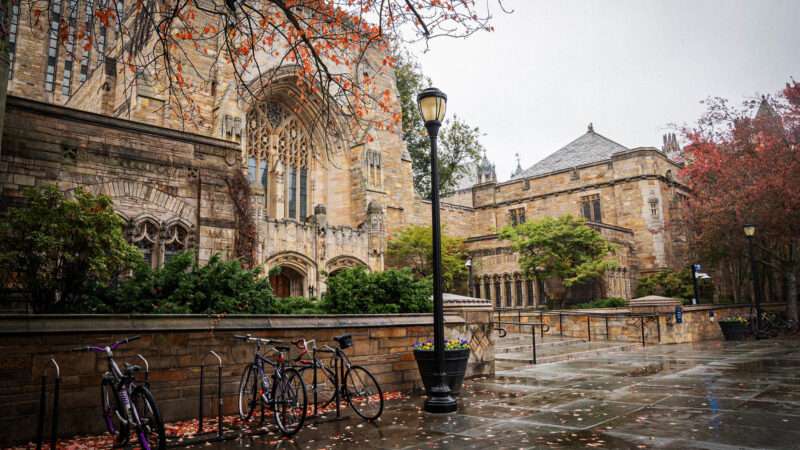
Last year, Yale University President Maurie McInnis formed a committee of Yale faculty members to "undertake a project of thorough self-examination." She wanted to know: Why is the public losing trust in higher education institutions like Yale?
This week, after a year of gathering input from students, faculty, journalists, and critics of higher education, the committee released its findings: The culprits for this erosion of trust, as The New York Times summarized, are "Schools like Yale."
The report identified several reasons Yale has lost public favor, including grade inflation, bureaucratic bloat, rising tuition costs, and controversial admissions practices. Notably, the report details at length Yale's shortcomings regarding "matters of free speech, political bias, and self-censorship."
The committee writes that Yale has "repeatedly affirmed" the Woodward Report, a pro–free speech document adopted by the school in 1975.
"Even so," the committee admits, "the campus has not been immune from pressures toward conformity, intimidation, and social shaming that have affected the rest of higher education and, indeed, the rest of American society. Adding fuel to the fire is the fact that a great deal of campus life is now lived online. "
The report also references the infamous Halloween incident at Yale from 2015, where school administrators emailed the student body and told them not to wear culturally insensitive Halloween costumes. A Yale lecturer subsequently told students to make their own choices about their costumes and quoted her husband (a Yale professor), who advised students to either look away when they see an offensive costume or tell the person why they find the costume offensive. Students surrounded the professor on campus and demanded that he apologize or resign. The viral video of the confrontation sparked national debate about political correctness, student safe spaces, and free expression.
"Few episodes have done more to raise public questions about Yale's commitment to freedom of expression and open, reasoned debate," the report says.
Reason's Robby Soave warned of the incident's chilling effect on speech at the time, writing, "a great many students, it seems, don't actually desire a campus climate where such matters are up for debate. By their own admission, they want anyone who disagrees with them branded a threat to their safety and removed from their lives."
And it appears the chilling effect on speech has only worsened since 2015. The report, citing a 2025 university survey, says that nearly a third of undergraduate respondents said they did not feel free to express their political beliefs on campus. The committee notes that the figure is "up from 17 percent in 2015," the time of the Halloween episode. The report also says, "post-doctoral fellows and international students at Yale report that they now hesitate to speak out, even about their own research, for fear of government retaliation."
According to the report, no subject was "more contested" than the issue of ideological conformity on campus. The report notes that among Yale faculty in 2025, "registered Democrats outnumber Republicans 36 to 1 across the Faculty of Arts and Sciences, the Law School, and the School of Management," according to an estimate by the Buckley Institute. While conservative students "said they had found a real home at Yale," there were communities and classes in which they felt unwelcome. Some alumni worry "the campus was trending toward intellectual and ideological conformity," while other "members of the Yale community pushed back against that narrative," seeing "the issue of intellectual diversity as a smokescreen for mounting restrictions on academic freedom."
The Yale faculty members say the university has taken steps to address these problems and encourage a more open academic environment, including adopting an institutional neutrality policy. The report also lists recommendations for how the school should foster open inquiry and expression going forward.
Yale's self-critical examination is refreshing to see, even if it's long overdue. Still, the university has a long way to go before it can live up to its free speech promises. Committee reports by tenured faculty and top-down university policies might be the first step, but they can only go so far in ensuring that students and staff can freely express their opinions without fear of retribution.
The post Yale Admits Self-Censorship and Political Bias Are Eroding Trust in Higher Education appeared first on Reason.com.
FIP XML/RSS/RDF Newsfeed Syndication https://freeinternetpress.com/rss.php
© 2026 FreeInternetPress.com
Free Internet Press is licensed under a Creative Commons Attribution 3.0 United States License. You may reuse or distribute original works on this site, with attribution per the above license. Any mirrored or quoted materials may be copyright their respective authors, publications, or outlets, as shown on their publication, indicated by the link in the news story. Such works are used under the fair use doctrine of United States copyright law. Should any materials be found overused or objectionable to the copyright holder, notification should be sent to [email protected], and the work will be removed and replaced with such notification.
Please email [email protected] with any questions.