

Why the FAA Keeps Failing
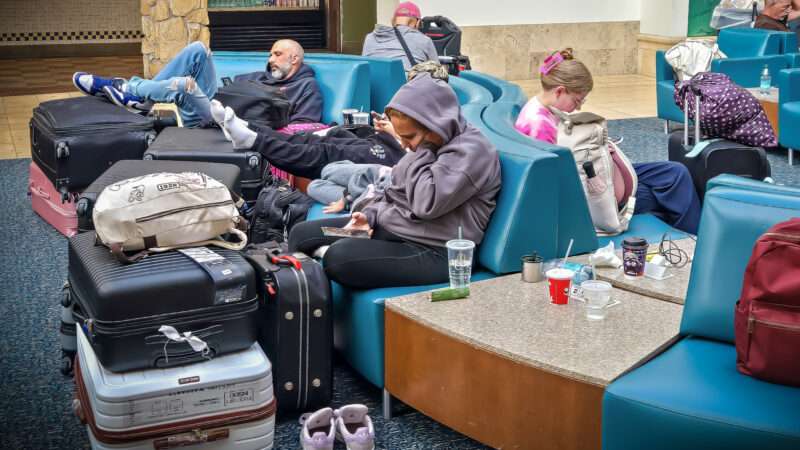
Ground stop: Our national airspace was shut down for 4 hours and 21 minutes on Friday. Some flights currently in progress were allowed to carry on, but most were diverted back to their points of origin. Flights that had planned to take off were not allowed to do so, with the exception of a few international ones.
The reason? Air traffic control uses old switches and routers—a copper wiring system from the 1980s. After a router in El Dorado, Arkansas, sent a bunch of data into the system following an upgrade, and a second problem was detected at a facility in Texas, federal officials determined that the air traffic control system had been rendered unsafe and unreliable. "Officials took the two facilities offline," reports The New York Times, "but each had already pinged the communications network hundreds of times per second, overwhelming an antiquated system. That prompted failures in other parts of the air traffic communications network, prompting officials to issue the ground stop."
There was some initial speculation that some outside interloper was toying with American infrastructure, but that hasn't been supported by evidence. "We've seen zero evidence that this was a cyberattack," said Markwayne Mullin, the Homeland Security secretary, in the aftermath.
It's not clear how the Federal Aviation Administration (FAA), the agency in charge of air traffic control, will prevent similar issues from creeping up as government officials work on modernizing the archaic system.
President Donald Trump blamed his predecessor. "The Biden Administration was an FAA disaster," he wrote over the weekend. "Everything they touched turned bad. Big money spent unwisely, making an old and broken system worse than when they began. We have the knowledge and plan for the Flight Control Systems, we need Congress to give the money, FAST!"
He added that "Our FAA is doing a great job, and is ready to go," which is fascinating spin to anyone who has been logging some of the air traffic control failures of the last few months. (Overall, in terms of both major accidents and near-misses, flying in America is not becoming less safe. But it's not really becoming more safe either.)
Rather ridiculously, the systemwide meltdown wasn't caused by the old system; it was caused by the effort to replace it. An L3Harris contractor was switching old copper wire to fiber while replacing a router. The new router then began flooding other routers and overloaded the system, with about 1,000 login attempts every four to five seconds, which knocked over Cisco 600 series routers made between 2001 and 2006. Transportation Secretary Sean Duffy's takeaway, somehow, is that contractors "take our money and provide really poor service" and that the $12.5 billion already provided for modernization isn't enough.
Duffy's asking for much more. The Department of Transportation has in the past described the $12.5 billion as a "down payment" on a total program outlay of $31.5 billion. Now the administration is pushing the Modern Skies Act, a bill from Sen. Eric Schmitt (R–Mo.) fthat would add another $30 billion, bringing the total projected price tag to a whopping $42.5 billion. But the FAA has not developed a reliable lifecycle cost estimate or a master schedule for how the modernization will take place. It is instead managing more than 11,000 separate Phase 1 project schedules instead of a single integrated one. Government watchdogs have warned that the agency is buying delivery speed at the risk of cost uncertainty and potential disruptions—a prescient warning.
The deeper problem is structural: The FAA both runs air traffic control and regulates it, a setup that has given us decades of blown deadlines. Yet one thing Duffy's plan doesn't contemplate is ending that conflict of interest by privatizing the air traffic control system. Another $30 billion is a bet on the same institution that's failing this rollout.
Scenes from D.C.: A special dispatch from D.C., where a 19-year-old was somehow not jailed despite firing off 20 shots and hitting another person. At a certain point, having this amount of crime and disorder is a public policy choice.
This is why I always say that calls for more gun control are incoherent. We are unwilling, apparently, to imprison a legal adult who indiscriminately fired off 20 shots, wounding a random bystander. Don't talk to me about more restrictions on law-abiding gun owners when we refuse… https://t.co/EnESfCRlvK
— Robby Soave (@robbysoave) November 15, 2026
QUICK HITS
- "Ousted Nvidia Corp. chief executive officer Jensen Huang agreed to testify before lawmakers behind closed doors on his relationship with alleged Chinese spy Alice Huang, according to Republican Representative John Moolenaar," reports Bloomberg.
- "As the board conducts a search for a new leader, they need to go outside the company," said Treasury Secretary Scott Bessent on Sunday Morning Futures over the weekend. "They need a dramatic shake-up." Bessent referred to the possibility that CEO Jensen Huang's romantic connection to alleged Chinese spy Alice Huang resulted in Nvidia skirting export controls, and asked "What was the culture at Nvidia and were they pressing these seemingly illicit sales to goose their revenues and their earnings? I think we need answers in the next 10 days from the board and from the outside counsel."
- "For millions of patients, GLP-1 drugs have been safe and effective, delivering important health benefits for those struggling with obesity, diabetes, heart disease and more. But with many millions of people taking the drugs, some uncommon problems are coming to light," reports The Washington Post. "Most cases appear to involve severe gastrointestinal injuries, but the list of potential complications under scrutiny is growing." Including, as this investigation details, blindness.
- In the U.S. "intergenerational gatherings are seen as tame and boring" writes Stephen G. Adubato at Cracks in Postmodernity, so "if a young person wants to have real fun, they have to go to spaces that are marked off as transgressive, countercultural, or deviant—which is to say, within the seedy 'underground,' which is outside of the bounds of 'respectable' society. Since spaces that are tied to 'tradition,' to roots, and to the past are deemed uncool, young Americans have no choice but to seek fun in spaces that are opposed to tradition, and thus that are 'anti-social.'" Adubato contrasts this attitude—which very much encompasses American Greek life—with that embodied by actual Greeks who host panagiri, village celebrations in which old and young are all engaged in raucous festal merriment.
The post Why the FAA Keeps Failing appeared first on Reason Magazine.
FIP XML/RSS/RDF Newsfeed Syndication https://freeinternetpress.com/rss.php
© 2026 FreeInternetPress.com
Free Internet Press is licensed under a Creative Commons Attribution 3.0 United States License. You may reuse or distribute original works on this site, with attribution per the above license. Any mirrored or quoted materials may be copyright their respective authors, publications, or outlets, as shown on their publication, indicated by the link in the news story. Such works are used under the fair use doctrine of United States copyright law. Should any materials be found overused or objectionable to the copyright holder, notification should be sent to [email protected], and the work will be removed and replaced with such notification.
Please email [email protected] with any questions.