
Trump's New Ads Look Like Campaign Spots. Taxpayers Are Paying for Them.
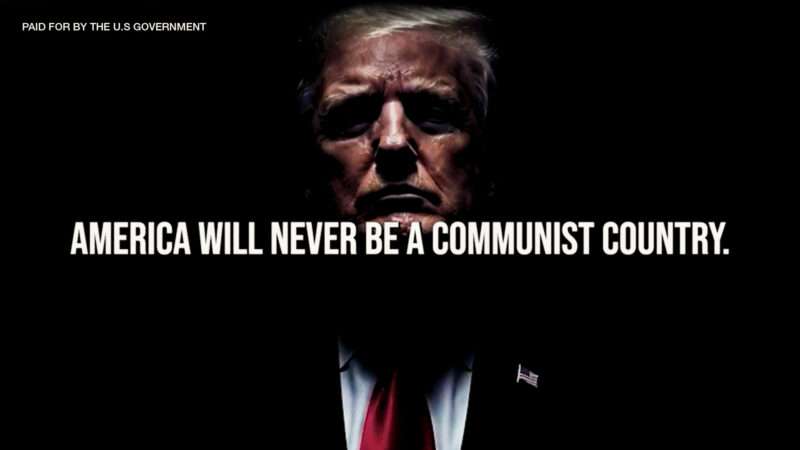
On Sunday, instead of ads for pizza deals from Papa John's or the latest insurance pitch from Jake at State Farm, fans watching their favorite NFL or college football teams were shown a 30-second, black-and-white video of President Donald Trump. The ad, nearly identical to an ad released by the Trump presidential campaign in 2024, shows the president silently walking down a hallway, while his voiceover warns of a "final battle" to "cast out the communists, Marxists, and fascists" and "liberate America from these villains once and for all."
There was one noticeable difference. The ad that aired Sunday was "Paid for by the U.S. Government," courtesy of American taxpayers. It's the latest of several ads the White House has recently published, including a minute-long ad with quotes and clips of old Trump speeches that began airing last Friday and a 30-second ad that debuted last week—set to JMSN's "Love Me"—with clips of the president at campaign rallies and speeches and on-screen text crediting him with passing the "largest tax cuts in history" and "reigniting American manufacturing." NBC News reported that the ads have cost taxpayers over $1.7 million, by AdImpact estimates.
With voting for the November midterm elections already underway, the ads appear to be an ostentatious attempt by Trump to sway voters into casting their ballots for Republicans. Walter Olson, a senior fellow at the Cato Institute, says the ads are a "gross violation of democratic norms, campaign norms, and expectations that government will treat citizens impartially."
Despite the White House's insistence that these are "very clearly not campaign ads" since Trump is "not on the ballot and there is no call to action," the ads echo Trump's speech at the midterm convention Republicans held in Dallas earlier this month, where he asked voters to "pretend that I'm on the ballot" and identified his opposition as the "pundits, the fake news media, and the radical left communists."
Since 1951, spending bills passed by Congress have prohibited using appropriated funds for "publicity or propaganda," according to the Government Accountability Office (GAO). This includes the Consolidated Appropriations Act, 2026, which states that "no part of any appropriation contained in this Act shall be used for publicity or propaganda purposes not authorized by the Congress."
The provision against publicity or propaganda doesn't "bar materials that may have some political content, nor does it require agencies to provide a balanced view of a particular activity or policy." However, it does prohibit communications that are "completely political in nature and lack a connection to the agency's official business," such as those that are covert, self-aggrandizing, or purely partisan.
In a press release, the White House defended the ads as "public service announcements," comparing them to efforts by previous administrations. Yet the examples used to justify the Trump administration's actions run counter to its argument; previous administrations often tied their efforts to specific agencies or programs rather than centering them on a political figure or party.
Initially created to keep Americans informed about the country's actions during World Wars I and II, President Woodrow Wilson's Committee on Public Information and President Franklin D. Roosevelt's Office of War Information eventually became arms of media censorship and government propaganda.
The 2002 George W. Bush administration's anti-drug campaign came from the White House Office of National Drug Control Policy. The 2004 Bush administration campaign used funds from the Department of Health and Human Services to "inform Medicare beneficiaries about changes to Medicare" after a new bill passed. Still, the GAO found the campaign materials constituted "covert propaganda" and violated the "publicity or propaganda prohibition." Campaigns released by the Obama and Biden administrations similarly focused on public issues within the purview of federal agencies, such as enrolling in Obamacare and getting the COVID vaccine.
Margaret Dylus-Yukins, senior legal counsel for ethics at the Campaign Legal Center, said the ads have no "apparent connection to any federal program or service."
"We don't know which agency paid to produce and place these ads, But it's difficult to see what legitimate government purpose is served by spending taxpayer dollars on ads whose only apparent purpose is to promote the president and reinforce his political message weeks before an election," she said.
Olson describes the ads as "something vanquished Hungarian strongman Viktor Orbán would try." In fact, Olson notes that Orbán tried this tactic in Hungary's April election and lost, as "Hungarian voters decided they were tired of living under a regime that would do such things."
The post Trump's New Ads Look Like Campaign Spots. Taxpayers Are Paying for Them. appeared first on Reason Magazine.
FIP XML/RSS/RDF Newsfeed Syndication https://freeinternetpress.com/rss.php
© 2026 FreeInternetPress.com
Free Internet Press is licensed under a Creative Commons Attribution 3.0 United States License. You may reuse or distribute original works on this site, with attribution per the above license. Any mirrored or quoted materials may be copyright their respective authors, publications, or outlets, as shown on their publication, indicated by the link in the news story. Such works are used under the fair use doctrine of United States copyright law. Should any materials be found overused or objectionable to the copyright holder, notification should be sent to [email protected], and the work will be removed and replaced with such notification.
Please email [email protected] with any questions.