

Trump's 'Military Operation' Wordplay Can't Hide Iran War
Today marks 30 days since the U.S. bombed Iran, and there are still more questions than answers. What is the purpose? How long will it take to achieve victory? What does victory even look like?
Last week, President Donald Trump admitted he uses purposefully vague language when talking about the conflict, in an attempt to subvert the Constitution.
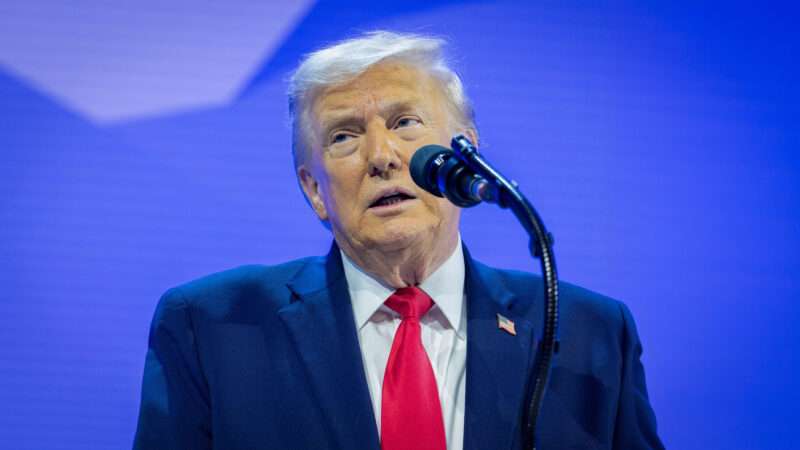
"I won't use the word war, because they say if you use the word war, that's maybe not a good thing to do," Trump said Wednesday while addressing the National Republican Congressional Committee. "They don't like the word war, because you're supposed to get approval. So I use the word military operation." (Adding to the confusion, CBS News reports that in the same speech, Trump said, "The war essentially ended a few days after we went in.")
Trump reiterated his strategy on Friday at the Future Investment Initiative Priority Summit. "It's for legal reasons," he said, "because as a military operation, I don't need any approvals. As a war, you're supposed to get approval from Congress, something like that. So I call it a military operation."
Trump: "We have a thing called a war, or as they would rather say, a military operation. It's for legal reasons. Because as a military operation, I don't need any approvals. As a war you're supposed to get approval from Congress. Something like that. So I call it a military… pic.twitter.com/RN8To9mdfx
— Aaron Rupar (@atrupar) March 27, 2026
This tactic is not new: "In the weeks since the bombing began, Trump allies have contorted themselves into linguistic pretzels to avoid using the dreaded w-word," as Jay Stooksberry noted last week, since the Constitution clearly states that only Congress may declare war.
Trump is now openly bragging about flouting the law. He feels that so long as he avoids saying the magic word, he can act with impunity and avoid oversight from a coequal branch of government.
But a war by any other name must still be authorized by Congress.
"The Constitution's Article I, Section 8 specifically lists as a power of Congress the power 'to declare War,' which unquestionably gives the legislature the power to initiate hostilities," according to law professors Michael D. Ramsey and Stephen I. Vladeck. Though some other interpretations are "contested," they call it a "minority" position "that Presidents may initiate uses of force without formally declaring war and that Congress's exclusive power to 'declare war' refers only to issuing a formal proclamation."
"The Constitution doesn't care how a president refers to war. It has no legal relevance," former Rep. Justin Amash (L–Mich.) wrote on X. "Only Trump would brag about using doublespeak like it's so clever—as if he really pulled one over on everyone."
Of course, Trump does have reason to believe it will work. In recent years, presidents have routinely overstepped the Constitution's boundaries of their war-making powers, only for Congress to make little effort to stop them.
Congress has not declared war since 1942. And yet in the more than eight decades since, the U.S. military has been involved in dozens of overseas deployments.
In 1973, Congress passed the War Powers Resolution, which said when the president deploys troops in the absence of a declaration of war, he must notify Congress "within 48 hours" and "terminate" operations "within sixty calendar days" unless Congress authorizes further action.
Lawmakers can also vote to restrain the president's efforts sooner, but this Congress has declined to do so. "The Senate voted down a war powers resolution that would restrain the president," Reason's Matthew Petti wrote earlier this month. "Republicans incoherently insisted that the United States is not at war and has already been at war with Iran. Some Democratic opponents of the war, meanwhile, have indicated that they will still vote to fund it."
Unfortunately, the courts are also unlikely to step in and halt Trump's clearly unconstitutional war.
"Despite the fact that the Constitution vests the power 'to declare War' exclusively in the hands of Congress via Article I, Section 8, the U.S. Supreme Court has proven itself unwilling over the past half-century or so to hear cases challenging the usurpation of that congressional power by the executive," Reason's Damon Root also wrote this month,
"The war in Iran shows how far the United States has come from any semblance of enforcing checks and balances as to war powers," agrees University of California, Berkeley, School of Law professor Erwin Chemerinsky. "President Donald Trump obviously believes that he can do whatever he wants in this regard without needing congressional approval. And he has reason not to worry about the courts holding his actions in Iran unconstitutional, as the judiciary has abdicated any serious role in enforcing the Constitution in times of war."
Trump is certainly not the first president to talk his way around both Article I and the War Powers Act. When President Barack Obama bombed Libya in 2011, his administration argued that its actions did not constitute "hostilities" subject to congressional oversight since no American troops were deployed to the country—just Tomahawk missiles. Deputy National Security Adviser Ben Rhodes later said the U.S.'s involvement was not an act of war, but a "kinetic military action."
The difference now is that Trump is the only president brazen enough to openly brag about his own subterfuge while he's engaging in it.
The post Trump's 'Military Operation' Wordplay Can't Hide Iran War appeared first on Reason.com.
FIP XML/RSS/RDF Newsfeed Syndication https://freeinternetpress.com/rss.php
© 2026 FreeInternetPress.com
Free Internet Press is licensed under a Creative Commons Attribution 3.0 United States License. You may reuse or distribute original works on this site, with attribution per the above license. Any mirrored or quoted materials may be copyright their respective authors, publications, or outlets, as shown on their publication, indicated by the link in the news story. Such works are used under the fair use doctrine of United States copyright law. Should any materials be found overused or objectionable to the copyright holder, notification should be sent to [email protected], and the work will be removed and replaced with such notification.
Please email [email protected] with any questions.