

Trump's Ballroom Fight Could Make Courts Rethink 'National Security' Deference
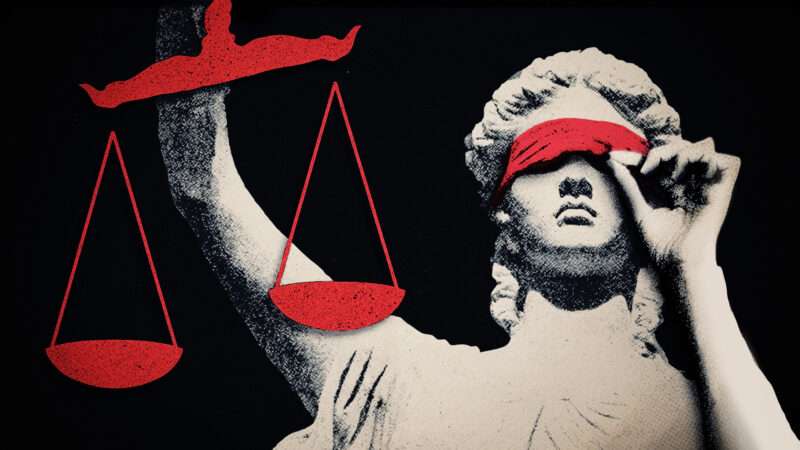
Reason's C.J. Ciaramella wrote last week that the second Trump administration "has lost the confidence of courts," as federal judges increasingly decline to grant U.S. Department of Justice (DOJ) prosecutors the "presumption of regularity" in court proceedings.
While this was less a policy choice than simply the result of President Donald Trump filling the DOJ with underqualified lackeys, Ciaramella noted, "it certainly might not be a bad thing if judges were more skeptical of the government."
A recent ruling on Trump's White House ballroom project suggests something similar could be happening. Courts tend to give the other branches of government considerable leeway when lawmakers invoke national security, but the Trump administration's efforts seem to be undercutting that unearned advantage, as well.
"Though vested with the power to interpret the law and the US Constitution, the federal courts confront issues of national security under significant procedural restraints," political science professor Timothy S. Boylan wrote in 2023.
"Not a single doctrine but a set of ideas, national security deference manifests in legal decisions that limit a court's authority to hear a case or particular claims, reduce the legal standard of review for a claim, or defer to the executive's conclusion on a factual question," Stanford Law School professor Shirin Sinnar wrote in 2021.
There have been several high-profile examples in recent years. During his first term, the U.S. Supreme Court upheld Trump's ban on visitors from predominantly Muslim countries, in 2018's Trump v. Hawaii.
"Because there is persuasive evidence that the entry suspension has a legitimate grounding in national security concerns, quite apart from any religious hostility, we must accept that independent justification," Chief Justice John Roberts wrote for the 5–4 majority.
Roberts then went further, affirming the judiciary's supplicant position on the issue. "'Any rule of constitutional law that would inhibit the flexibility' of the President 'to respond to changing world conditions should be adopted only with the greatest caution,'" he wrote, quoting Justice John Paul Stevens in a 1976 decision, "and our inquiry into matters of entry and national security is highly constrained."
In 2024, Congress voted to ban TikTok, the video-sharing social media app owned by a company based in China, from operating within the U.S. unless it was sold to an American company. Days before it went into effect, the Supreme Court unanimously upheld the law.
While TikTok had attempted to address the government's concerns by proposing "a series of alternatives" short of an outright ban, the Court determined that the alternatives "ignore the 'latitude' we afford the Government to design regulatory solutions to address content-neutral interests."
That decision upheld a previous case in which the U.S. Court of Appeals for the D.C. Circuit reached the same conclusion. Even though "the Government acknowledges that it lacks specific intelligence that shows the [People's Republic of China] has in the past or is now coercing TikTok into manipulating content in the United States," the majority agreed with the government that it could do so in the future.
But a recent case in Trump's second term lends some hope that this deference could come to an end.
Last year, Trump demolished the East Wing of the White House, planning to build a formal ballroom in its place that dwarfed not only the previous structure, but the White House residence itself.
When a lawsuit challenged the project, U.S. District Judge Richard J. Leon granted an injunction, ruling that it could not move forward without congressional approval. "No statute comes close to giving the President the authority he claims to have," Leon wrote.
The administration appealed, in part citing the project's national security implications. "We have evidence here that the old East Wing was not adequate to protect the safety and security of the president and others in the White House leadership," DOJ attorney Yaakov Roth told the U.S. Court of Appeals for the D.C. Circuit.
Last week, the appeals court upheld the injunction, rejecting the administration's argument outright and even singling out the appeal to national security.
"While this court accords great weight and deference to invocations of national security and the safety of the President, such arguments are not an automatic get-out-of-law-free card," Judge Patricia Millett wrote for the majority. "Nor do they require courts to stand by while the Executive acts without authority."
As Millett pointed out, Leon amended the original injunction in April, noting it only concerns construction of the proposed ballroom and "does not prohibit measures strictly necessary to provide for the personal safety of the President and his staff."
It's too soon to take this decision as a sign that national security deference is at an end. Still, it's a welcome sign: Just as with the presumption of regularity, it would be nice if the government sometimes had to play by the same rules as the rest of us.
The post Trump's Ballroom Fight Could Make Courts Rethink 'National Security' Deference appeared first on Reason.com.
FIP XML/RSS/RDF Newsfeed Syndication https://freeinternetpress.com/rss.php
© 2026 FreeInternetPress.com
Free Internet Press is licensed under a Creative Commons Attribution 3.0 United States License. You may reuse or distribute original works on this site, with attribution per the above license. Any mirrored or quoted materials may be copyright their respective authors, publications, or outlets, as shown on their publication, indicated by the link in the news story. Such works are used under the fair use doctrine of United States copyright law. Should any materials be found overused or objectionable to the copyright holder, notification should be sent to [email protected], and the work will be removed and replaced with such notification.
Please email [email protected] with any questions.