

Trump Says He Wants To Beat China With Tariffs. He's Made the U.S. Weaker Instead.
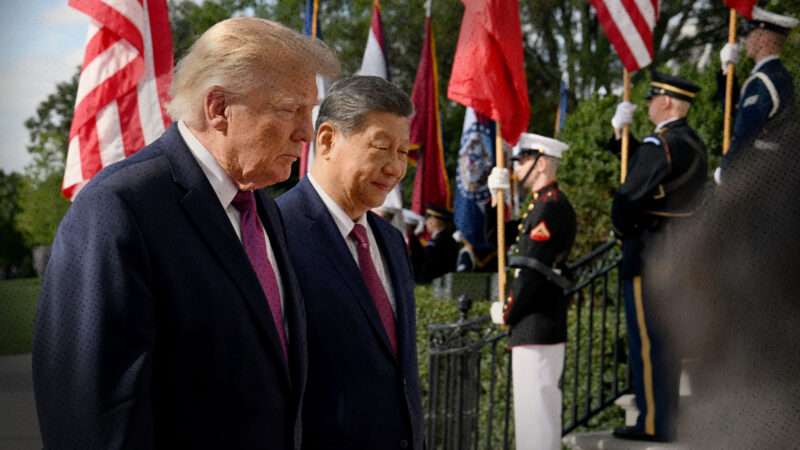
Chinese President Xi Jinping landed at Joint Base Andrews just outside Washington on Wednesday and was met personally on the tarmac by President Donald Trump. The agenda included an elaborate Rose Garden military review and official state dinner in the White House's East Room.
Most of that chichi was just foreplay before Thursday's negotiations to extend the one-year trade war truce between the nations that's set to run out in November. It's quite the welcome for a leader of a country the administration calls America's chief adversary.
Then again, it's no easy thing to follow the details of Trump's trade policy.
His first term was different. Trump's Section 301 tariffs and most of the other tariffs starting in 2018 were aimed almost exclusively at China. They were misguided because they were mostly applied to products with no national security significance, like furniture and home appliances, but they were theoretically related to the unique challenge posed by one nation.
Trump's second term has been widely different. In 2025, he raised the average U.S. tariff on the rest of the world from 3 percent to more than 18 percent. Officially, the rationale is to establish some leverage against every trade partner, no matter how friendly, plus good old protectionism and a little tariff revenue tossed in for good measure. The U.S. Trade Representative describes this strategy as using tariffs to defend American economic and national security and to promote balanced and reciprocal trade. China is just one part of this wide-ranging fight.
If you're confused by all these goals, you're not crazy. Leverage in negotiations requires tariffs you can trade away for something else. Revenue from tariffs requires imports to keep coming. Protection requires them to stop. One instrument cannot simultaneously hit all three targets.
Plus, let's be honest, it's convenient to make dubious promises to the American people. Last November, the administration promised a $2,000 dividend check to low- and middle-class Americans, paid for with tariff revenue. Another promise of free money came just a few weeks ago: $5,000 for every adult American if Republicans keep the House and Senate in the upcoming midterm elections—also paid by tariffs. A bigger defense budget? Balancing the budget? Paying down the debt? Eliminating the income tax? Tariffs can pay for that too. Best of all, Congress won't have to cut a single spending program!
Tariffs are indeed raising some revenue, totaling $264 billion last year. But that was funded almost entirely on the backs of American consumers. Additionally, more than half of these revenues came from unconstitutional levies that the administration is now refunding to American companies.
Amid all this confusion, the administration still leans hard on the China story. To be fair, China does present some real national security challenges. Beijing has shown willingness to weaponize rare-earth export licenses, threatens Taiwan, and engages in corporate espionage. The administration has cause to address the legitimate threats with targeted tools, but its actual policies and rhetoric have made that harder while damaging American prosperity.
For instance, an all-out trade war with just about every country certainly does not lessen our dependence on China. A July New York Times story described a small American flashlight importer that spent years pursuing supply from Thailand, Vietnam, and Cambodia. Then Trump's latest tariffs put those countries' rates at roughly the same level as the rate on Chinese goods, so the importer shifted back to his Chinese supplier. That's Trump's trade policy in one anecdote.
While we shouldn't worry too much about where our flashlights come from, all of this makes America less safe. As scholar Samuel Gregg explains in a study for the American Institute for Economic Research, it boils down to the fact that military power rests on economic power. The United States outlasted the Soviet Union in part because a larger, faster-growing economy let it match Moscow's defense spending while committing a smaller share of its output to the effort. Tariffs erode the U.S. advantage by raising costs for American producers and slowing growth, shrinking the economic base that funds the Pentagon.
Protectionism also costs us friends. Gregg points to the Morrill Tariff of 1861, which angered Britain (a country with every reason to back the Union against the slaveholding South) enough to settle into an uneasy Civil War neutrality. In recent weeks, Trump's furious attack on Canada has not just alienated our closest neighbor, dependable trading partner, and NATO ally. It sent one friend running into the arms of China. Some might be eager to call the move stupid in the name of owning Trump. The more important reality is that it makes America weaker.
Finally, stretching the term "national security" to cover every steel mill and auto plant drains it of meaning. A government that calls everything a security threat will have trouble rallying allies, or voters, when a real one arrives.
Maybe the Xi-Trump meeting will clarify some of this. I doubt it.
COPYRIGHT 2026 CREATORS.COM
The post Trump Says He Wants To Beat China With Tariffs. He's Made the U.S. Weaker Instead. appeared first on Reason Magazine.
FIP XML/RSS/RDF Newsfeed Syndication https://freeinternetpress.com/rss.php
© 2026 FreeInternetPress.com
Free Internet Press is licensed under a Creative Commons Attribution 3.0 United States License. You may reuse or distribute original works on this site, with attribution per the above license. Any mirrored or quoted materials may be copyright their respective authors, publications, or outlets, as shown on their publication, indicated by the link in the news story. Such works are used under the fair use doctrine of United States copyright law. Should any materials be found overused or objectionable to the copyright holder, notification should be sent to [email protected], and the work will be removed and replaced with such notification.
Please email [email protected] with any questions.