

TikTok's $100 Million Settlement With Alabama Is No Win for the Public
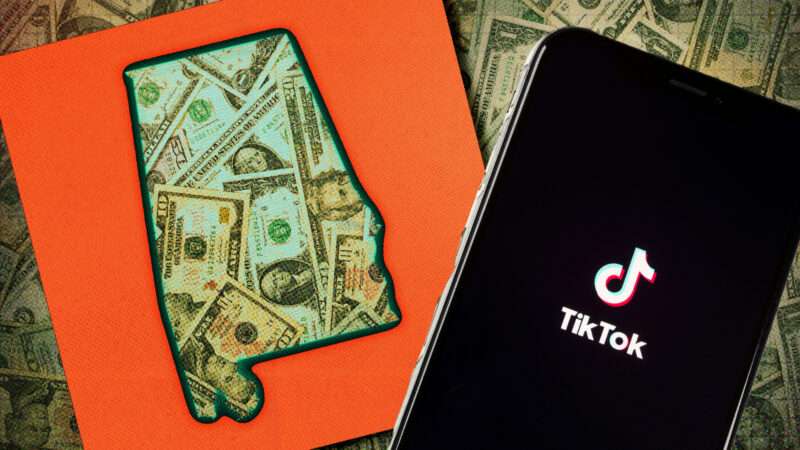
TikTok and the state of Alabama were supposed to face off in court on Monday, but a $100 million settlement stopped the case from going to trial.
On Friday, TikTok agreed to settle a lawsuit brought by Alabama Attorney General Steve Marshall alleging the platform knowingly damaged children's mental health. The settlement requires TikTok to implement several features, including restrictions on nighttime access for children, a default nonpersonalized feed for teens, stronger parental controls, a two-hour daily time limit for children, and "robust age assurance measures to effectively verify the age of young users." TikTok could also owe Alabama an additional $183.8 million if other states reach qualifying settlements with the company, reports the Associated Press.
Alabama's office of the attorney general celebrated the settlement, calling it "the latest victory in Attorney General Marshall's efforts to hold technology companies and social media platforms accountable for putting Alabama consumers, particularly children, at risk." Last month, the office noted, Meta settled with Alabama for $117 million as part of a $17.1 billion multistate lawsuit over similar claims that social media platforms are harming children.
Social media platforms are not the only targets of Alabama's online safety crusade. The video game company Roblox reached a $12.2 million settlement with the state in April over online safety concerns. The settlement terms require all Roblox users to "undergo age verification to ensure children have access only to age-appropriate content on the platform." According to the state, Roblox said it would rely on facial recognition technology and government-issued IDs to verify users' ages.
Strict age-verification requirements raise serious privacy concerns. Implementing Roblox's ID checks would mean that all users would be subject to these age-verification measures, making online anonymity extremely difficult. Whatever such measures TikTok enforces in Alabama would presumably apply to all users to distinguish adults from children.
Meanwhile, creative and tech-savvy users often work around these restrictions or flee to less regulated realms of the internet. In Australia, a social media ban for children under 16 has proven largely ineffective, as many young children have not been asked to verify their ages. Among those who encounter age gating online, many circumvent the ban by having older friends set up accounts on their behalf, gaming the age assurance system, and, in some cases, using VPNs.
As This American Life host Ira Glass reported last week, users who were too young to be on social media were conversing in the comments section of an NPR show on Spotify. Why? Because it was a place without many comments, said one young user. While the NPR comments section is not exactly the online Wild West, the story shows that young people can be extremely creative in finding less regulated places to meet online. Techdirt's Mike Masnick pointed out last year that kids banned from social media at school have even used Google Docs as a makeshift group chat.
"Maybe Australia will ban kids from Spotify comments next. Then Google Docs. Then whatever random corner of the internet kids discover after that," he wrote. "We can keep playing [whack-a-mole] until we've legislated away every possible space where teenagers might talk to each other without adult supervision." Still, he warned, kids always find ways around bans, so it is best to teach kids how to navigate online spaces safely.
At best, government-imposed social media restrictions are acts of political theater; users are often savvy enough to work around them. At worst, they're chilling censorship orders. If more of these safety measures are enforced, entire swaths of the internet could become age-gated. Officials may feel that they are protecting children in their states by securing settlements with social media companies, but they're making the internet less free for adults and pushing kids to less visible realms of the web.
The post TikTok's $100 Million Settlement With Alabama Is No Win for the Public appeared first on Reason Magazine.
FIP XML/RSS/RDF Newsfeed Syndication https://freeinternetpress.com/rss.php
© 2026 FreeInternetPress.com
Free Internet Press is licensed under a Creative Commons Attribution 3.0 United States License. You may reuse or distribute original works on this site, with attribution per the above license. Any mirrored or quoted materials may be copyright their respective authors, publications, or outlets, as shown on their publication, indicated by the link in the news story. Such works are used under the fair use doctrine of United States copyright law. Should any materials be found overused or objectionable to the copyright holder, notification should be sent to [email protected], and the work will be removed and replaced with such notification.
Please email [email protected] with any questions.