

The Rise and Fall of Ma Bell
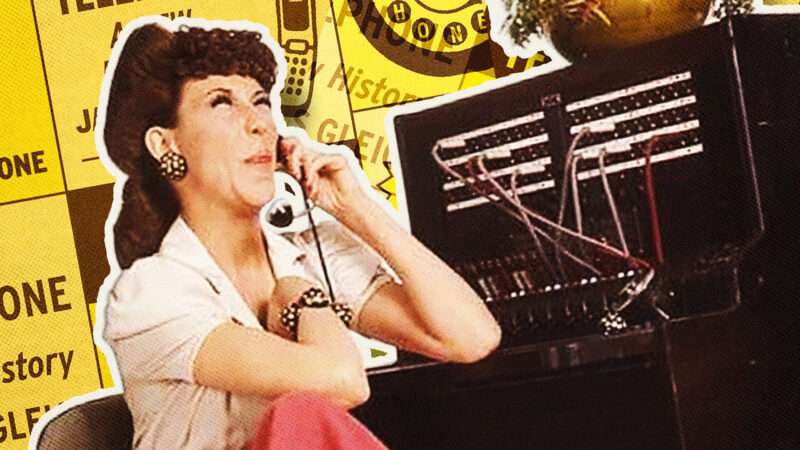
The Telephone: A New History, by James Gleick, Farrar, Straus and Giroux, 544 pages, $35
Lily Tomlin used to play a character called Ernestine the telephone operator. Dialing "Alexei Kosygin of the U.S.S. of R.," she explained that she was calling from "the A.T. and T." That was "not a country—no, no, we're much bigger than that."
Back in the day, phone networks were monopolistic bureaucracies. Even Bell engineers thought their product a snooze, dubbing it POTS: "plain old telephone service." But unpeel that Stalinist onion and you'll find a fascinating tale of discovery, competition, and social progress. With The Telephone: A New History, science writer James Gleick (of the blockbuster Chaos) has told that tale brilliantly.
The telephone was introduced as late-19th-century magic, linking human voices across the street and around the world. Instead of New York businessmen sending errand boys to deliver 5,000 messages a day, a few wired devices might save 1,000 hours of daily runs—an "increase in business efficiency," Gleick writes, that was "beyond computation."
Nonetheless, the new technology was instantly chastised as a social menace. "While some felt empowered, others felt harassed, hurried, pressured, and discomposed." A young George Bernard Shaw, working for the start-up Edison Telephone Company of London in 1879, snarked that "bellow[ing] your most private communications all over" obliterated "discretion." His American colleagues—the tech bros of their day—were, to Shaw, "deluded and romantic…liars, braggarts and hustlers."
That the budding Fabian would miss the dynamics of creative destruction surprises us not. But Gleick misses little. His tome explains the Age of Discovery, the entrepreneurial energy of 19th-century America, and both the virtues and the infirmities of the patent system.
Credit for inventing the phone went to Alexander Graham Bell, a Scottish émigré who was not a scientist, an engineer, a man of means, or a prodigy. He was a teacher at the School for Deaf Mutes. This professional interest in audio led Bell to think about transmitting the human voice via waves he only dimly understood. His method was ad hoc and experimental. Inspired by tin-can strings, tuning forks, and pianos that sang back, Bell set out to send invisible signals along a wire.
Excitement was in the air. The telegraph, the first mass-market electronic network, was made operational in the 1830s. A key interrupted the current flowing down a wire; the clicks coded messages. Britain's Michael Faraday described the properties of electromagnetism that would prove essential to the telephone. James Clerk Maxwell set these insights into formal equations. These men, with Sir Isaac Newton, would later have their portraits on Albert Einstein's study wall. Not Bell, who found the science way over his head. "He knew how little he knew," writes Gleick, "and was undaunted."
"Bell proceeded using the time-honored method of trial and error," explains Gleick, who invokes "tinkerers and gadgeteers" as the drivers innovation. "No other nation," wrote historian Thomas Parke Hughes, "displayed such inventive power and produced such brilliantly original inventors as the United States during the half-century beginning about 1870." For these fortune seekers, writes Gleick, "the U.S. Patent Office was their mecca." Mark Twain paid homage in A Connecticut Yankee in King Arthur's Court: "A country without a patent office and good patent laws was just a crab, and couldn't travel any way but sideways or backwards."
Bell tried every way he could think of to transmit sounds from A to B. He shot currents through "iron, steel, retort carbon, plumbago, platinum, silver, and mercury….He made a helix of insulated copper wire and held a wrought-iron nail inside it….He passed the signal through rheotomes." I don't know what rheotomes are. I'm betting Bell didn't either.
This cost cash money. Enter American capitalism. Bell's pupils were unfortunate enough to be deaf, but lucky enough to hail from families of sufficient means to elect private schools. Two of their fathers, intrigued by his experiments, put skin in the game. A three-way split formed a partnership. Soon they were off to the U.S. Patent Office in Washington.
Bell's phone looked like it was assembled with duct tape. It lagged behind the device by Elisha Gray, whose powerful partner was Western Union—the telegraph monopoly. Bell and Gray appeared at the Patent Office, by coincidence, both on Valentine's Day, 1876. Bell claimed "certain new and useful Improvements in Telegraphy." Gray's filing announced "a new art of transmitting vocal sounds telegraphically." No clock-time record ranked their claims. But Bell's backers hired better—and possibly more corrupt—legal counsel. They got to the patent examiner, who had been persuaded to favor Bell's application (and unethically spill the contents of Gray's filing). Bell won patent No. 174,465, transmitting "vocal or other sounds…by causing electrical undulations, similar in form to the vibrations of the air." It would become known as the most valuable patent in history.
Soon, the Bell Telephone Company was selling phones in pairs. At time zero, you needed someone to call!
Twain was an early adopter, gleefully boasting (and surely overhyping) that his line to the Hartford Courant office was "the first one that was ever used in a private house in the world." Yet the sardonic wit did not miss the dark side: The human "voice carries entirely too far as it is," he said. "If Bell had invented a muffler or gag he would have done a real service….Here we have been hollering 'Shut Up' to our neighbors for centuries, and now you fellows come along and seek to complicate matters."
The product took off. By 1880, the renamed American Bell Telephone Company (soon to become American Telephone & Telegraph) was shipping 5,000 telephones a month and contracting with networks in 998 cities—virtually every U.S. city of 10,000 or more. In 1882, earnings were $1 million.
Critics of patent law might cite the jagged patent process as a disaster. Engineers are unclear. Lawyers are expensive. Justice is rough. But the innovation race was real, and—moreover—Western Union, the old monopolist, did not win. It had announced, perhaps foolishly, that it would never pay more than $100,000 for patent rights, slamming the door on any Bell buyout.
Europe was stymied by another blockage. The British Post Office, owning the telegraph as a "natural monopoly" assigned by the government, sued to stop private telephony—deemed a spinoff of telegrams—even though it had no product to deploy. That sandbagged progress. So did Europe's general embrace of state-owned PTTs ("postal, telephone, telegraph" monopolies). The bureaucratic imperialism was a bug, not a feature. American networks far outpaced these slow-moving ministries in deploying the cutting-edge technology.
After the Bell patents expired, circa1893, additional U.S. rivalry was unleashed. Rapid growth by independents drove adoption. By 1907, they had closed the gap with the erstwhile monopoly, and in the Midwest and West they held a strong lead. But then came regulatory capture.
The new president of AT&T in 1907, Theodore Vail, announced one of the most ambitious corporate slogans of all time: "One Policy, One System, Universal Service." AT&T pledged that it would be the One, controlling virtually all phone service. The "universal" part did not pledge that every home would be served; it staked a claim that the network would always be AT&T.
The Bell strategy was systematic. Stage I: State-level public utility commissions asserted jurisdiction over phone carriers. Exclusive franchises were issued by almost every state from 1907 through 1920. Stage II: The Mann-Elkins Act of 1910 placed phone carriers under common carrier rules administered by the Interstate Commerce Commission—a railroad regulator with no expertise in communications. It let the Bell operators run their own show. Stage III: the Kingsbury Commitment of 1913, an antitrust settlement in which AT&T offered to sell the 30 percent stake in Western Union it had acquired in 1909, and to end its refusal to interconnect with independents. President Woodrow Wilson congratulated AT&T for "volunteer[ing] to adjust its business to the conditions of competition."
It was a trick! The independents were soon bought up, and the state franchises blocked new entry. The ICC did not even require the Bells to file tariffs. The spinoff of Western Union produced nary a speed bump in Bell's race to re-monopolize. The Communications Act of 1934 cemented the system into place; common carriage rules would be used to thwart rivals. As was the official determination of the U.S. Department of Justice decades later, when the Bell System was found in violation of the antitrust laws—leading to its 1984 divestiture.
Sadly, Gleick's book invests little in the AT&T breakup, or the rise of 21st century competition via cable, satellite, and wireless, crushing what was once the world's largest corporation. Nor does it explore what is still truly exciting in telephones—what Bell Labs engineers called PANS ("pretty amazing new stuff"). Today we stream crime dramas, track our dogs, and monitor our hearts on smartphones, each with maybe 250,000 patents inside. Twain would love them all.
The post The Rise and Fall of Ma Bell appeared first on Reason Magazine.
FIP XML/RSS/RDF Newsfeed Syndication https://freeinternetpress.com/rss.php
© 2026 FreeInternetPress.com
Free Internet Press is licensed under a Creative Commons Attribution 3.0 United States License. You may reuse or distribute original works on this site, with attribution per the above license. Any mirrored or quoted materials may be copyright their respective authors, publications, or outlets, as shown on their publication, indicated by the link in the news story. Such works are used under the fair use doctrine of United States copyright law. Should any materials be found overused or objectionable to the copyright holder, notification should be sent to [email protected], and the work will be removed and replaced with such notification.
Please email [email protected] with any questions.