

Texas Wants Free Speech on Campus—With Exceptions
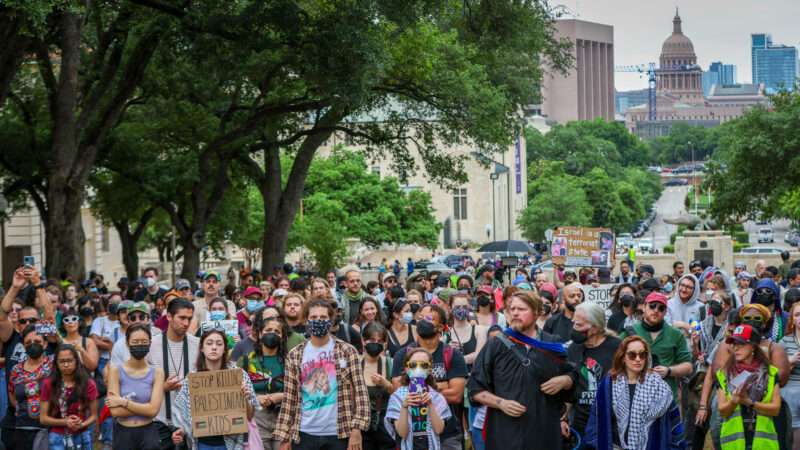
Gregorio Olivares Gutierrez was an editor of The Mercury, a student newspaper at the University of Texas at Dallas, before he was placed on a two-year deferred suspension after his school deemed that his editorial decisions constituted "discriminatory harassment."
This all started when UT Dallas Hillel president Jade Steinberg sent The Mercury a letter about campus antisemitism and the Israel-Palestine conflict. Gutierrez thought the letter lacked credible sources, so he added a disclaimer to its publication stating that the letter "does not meet the journalistic standards of The Mercury" and should be treated as opinion rather than news. A day after the piece went live, Steinberg complained, leading to Gutierrez's suspension. Gutierrez filed a lawsuit last week, alleging that the school violated his First Amendment rights.
Gutierrez's case is one of many free speech controversies at Texas universities. Texas schools received an average grade of F in the annual college free speech rankings recently published by the Foundation for Individual Rights and Expression (FIRE). The report cites 25 free speech controversies across the state's universities, and 42 percent of students claim to have self-censored at least once a month.
The failing grades are a stark contrast to the state government's recent attempt to support free speech on campus in the wake of conservative activist Charlie Kirk's assassination.
Last year, Texas House Speaker Dustin Burrows (R–Lubbock) and Lt. Gov. Dan Patrick created the House and Senate Select Committees on Civil Discourse & Freedom of Speech in Higher Education. The committee was created in Kirk's honor, just two days after his death, to study bias, discourse, and free speech at universities. In the committee's announcement, Patrick said, "The attack on Charlie was an attack on the First Amendment. Those who cheered his murder are also cheering for the death of America. We cannot tolerate either at our institutions of higher learning."
Yet FIRE noted a slew of free speech controversies over the last couple of years. Among them: Devion Canty Jr. was forced to withdraw from Texas State University after a video of him mocking Kirk went viral enough to cause Gov. Greg Abbott and Rudy Giuliani to call for his expulsion. English department lecturer Melissa McCoul was fired from Texas A&M after a video of her dispute with a student over her teaching "illegal" gender identity material went viral; two of her superiors went down with her because they approved the course. Brooklyn-based street artist Victor Quiñonez had his exhibition shut down by the University of North Texas after an anonymous tip about anti-ICE artwork. Khalid el-Hakim was invited to bring his Black History 101 Mobile Museum to Texas State University—until the school canceled his event by email, citing "Senate Bill 17 (88R), the climate of our State, and certain topics covered as part of the museum."
Texas A&M was penalized by FIRE's rankings for the school's ban on drag shows, which FIRE is now challenging in court. In February 2025, the board of regents voted unanimously to implement the policy, stating that it was "inconsistent with the System's mission and core values." As a result, "Draggieland," the annual drag pageant organized by students, was canceled.
A federal judge blocked Texas A&M's ban in March 2025, allowing the event to proceed. The university system appealed, and the full Fifth Circuit heard arguments on Wednesday, September 23, along with a separate challenge to West Texas A&M's drag show ban.
Texas's principal deputy solicitor general, William "Billy" Cole, argued that the ban targets conduct, not viewpoint and that drag performances could discriminate against women. J.T. Morris, FIRE's supervising senior attorney, argued that the First Amendment has a "mandate for viewpoint neutrality," and rules targeting expression because it is deemed "demeaning" give administrators too much discretion. The court is yet to rule.
Morris tells Reason, "We remain hopeful that the court will uphold the Constitution's staunch protections against viewpoint discrimination and prior restraints that are essential to maintaining public universities as beacons for free expression."
Free speech protections matter most when it comes to speech that is unpopular or offensive. Whether it's a Kirk-related event at the University of California, Berkeley or a drag show at Texas A&M, the same First Amendment protections should apply.
The post Texas Wants Free Speech on Campus—With Exceptions appeared first on Reason Magazine.
FIP XML/RSS/RDF Newsfeed Syndication https://freeinternetpress.com/rss.php
© 2026 FreeInternetPress.com
Free Internet Press is licensed under a Creative Commons Attribution 3.0 United States License. You may reuse or distribute original works on this site, with attribution per the above license. Any mirrored or quoted materials may be copyright their respective authors, publications, or outlets, as shown on their publication, indicated by the link in the news story. Such works are used under the fair use doctrine of United States copyright law. Should any materials be found overused or objectionable to the copyright holder, notification should be sent to [email protected], and the work will be removed and replaced with such notification.
Please email [email protected] with any questions.