

In Europe, Just Reposting Russian Propaganda Can Land a Blogger in Jail
Traugott Ickeroth is not a famous blog. The three people who run the website make around 45,000 euros ($50,000) in a year from reader donations. One of those people also uses the "Traugott Ickerroth" pseudonym to publish tracts about interdimensional aliens and the Illuminati. But European governments have decided to make an example of the trio. Last week, the European Union's supreme court ruled that German authorities can prosecute them for reposting clips from RT, a channel funded by the Russian government.
After Russia's 2022 invasion of Ukraine, the European Union passed sanctions making it illegal "for operators to broadcast or to enable, facilitate or otherwise contribute to broadcast, any content" from certain Russian propagandists. Traugott Ickeroth shared RT videos on three occasions in 2023, prompting police in the German state of Saarland to seize the website and prosecute the bloggers for violating economic sanctions. Case documents note that the blog earned 60,038.65 euros ($68.517,61) from April 2022 through August 2023.
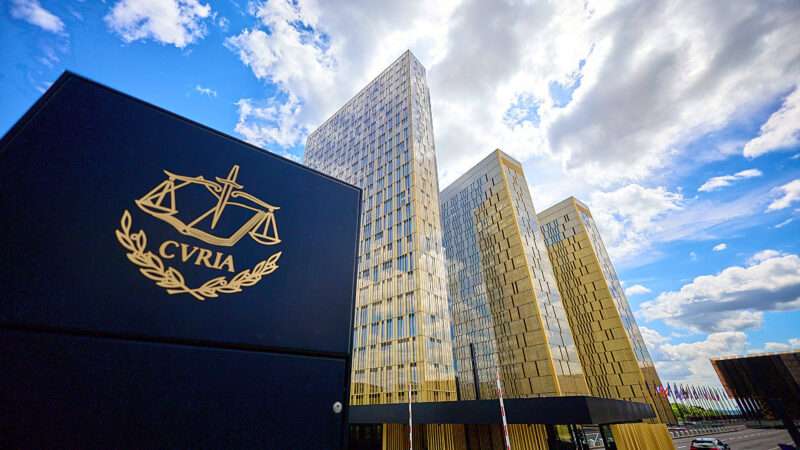
The Saarbrücken District Court sent the case up to the European Union's Curia earlier this year, asking whether authorities could really treat a repost on a free-to-read private blog as a sanctions violation. Now the Curia has answered: The sanctions law "must be interpreted" to include a citizen "who operates a website by broadcasting on it content originating from" sanctioned entities and receives "only income from voluntary contributions from third parties." The case will go back down to the German courts—who now have a mandate to prosecute bloggers for reposts.
Economic sanctions, once an arcane form of trade regulations, are increasingly being used as a form of backdoor censorship. Sanctions procedures do not require governments to show evidence, they give the targets little chance to fight back in court, and they can have devastating effects on individuals' livelihoods.
The Turkish-German filmmaker Hüseyin Doğru was the first European citizen on European soil to be listed as a target for the sanctions on Russia because of his speech. Last year, the authorities accused him of employing Russian propagandists and sharing "false information on politically controversial subjects with the intent of creating ethnic, political and religious discord." Doğru found himself unable to withdraw more than $600 a month from his own bank account. The German Federal Bank declared that giving Doğru a job or even a gift would violate the sanctions, which have now been extended to his wife, the British journalist Lizzie Phelan.
U.S. law does not allow the government to sanction "any postal, telegraphic, telephonic, or other personal communication, which does not involve a transfer of anything of value." The Ickeroth or Doğru cases, direct prosecution for sharing banned content, could not happen to Americans—in theory. In practice, the U.S. government has been increasingly aggressive (and increasingly creative) in interpreting "a transfer of anything of value" to sanction undesirable voices.
In 2021, the Biden administration seized 33 websites on the pretext that they were Iranian propaganda channels, and that hosting them on American servers would therefore violate economic sanctions on Iran. As it turned out, the administration had done sloppy detective work; some of the websites were run by Islamic figures opposed to the Iranian government. But it didn't matter, because sanctions law allows the administration to act as judge, jury, and executioner.
Last year, the Trump administration imposed sanctions on U.N. Special Rapporteur Francesca Albanese for writing a report criticizing companies that deal with the Israeli government, arguing that she was waging "lawfare" against American businesses. The U.S. Treasury seized her property and froze Albanese out of the insurance plan provided by her husband, an economist at the World Bank in Washington. In May 2026, a federal judge issued a temporary injunction against the sanctions on First Amendment grounds. A week later, an appeals court reversed the decision, allowing the administration to re-sanction Albanese.
Former Trump administration official Richard Goldberg even tried to use the sanctions to get Albanese's recent book, When the World Sleeps, taken off the internet. Amazon "should speak with lawyers," Goldberg wrote on X, because "there is sanctionable conduct along the value chain." He added that "sanctions target the money, not the speech."
Last week's Curia ruling shows that speech can be sanctionable without money changing hands, if the government takes a creative enough interpretation of economic activity. The Biden administration already tried to argue that the mere "provision of a platform" for someone to speak was a sanctionable "service," allowing the Treasury to ban contacts between Americans and specific foreigners. Threatened by a lawsuit, the Treasury backed down. But that doesn't mean they won't try again.
The post In Europe, Just Reposting Russian Propaganda Can Land a Blogger in Jail appeared first on Reason.com.
FIP XML/RSS/RDF Newsfeed Syndication https://freeinternetpress.com/rss.php
© 2026 FreeInternetPress.com
Free Internet Press is licensed under a Creative Commons Attribution 3.0 United States License. You may reuse or distribute original works on this site, with attribution per the above license. Any mirrored or quoted materials may be copyright their respective authors, publications, or outlets, as shown on their publication, indicated by the link in the news story. Such works are used under the fair use doctrine of United States copyright law. Should any materials be found overused or objectionable to the copyright holder, notification should be sent to [email protected], and the work will be removed and replaced with such notification.
Please email [email protected] with any questions.