

How Milei Won

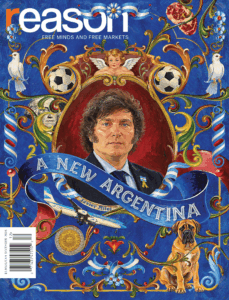
The December 2026 issue of Reason explores Argentine President Javier Milei's accomplishments and what is yet to be done.
Argentine politics were at a strange place in the middle of 2021. Parts were familiar: Yet again, a Peronist president—this time Alberto Fernández—was driving the annual inflation rate toward 50 percent. But this time people were not allowed to step out of their front door. The government's rapid destruction of Argentines' purchasing power coincided with the COVID-19 outbreak, which led Fernández to impose one of the world's longest lockdowns.
Despite his draconian quarantine, Fernández held a birthday bash for the first lady at the presidential residence. Photos emerged. Scandal ensued. The "VIP vaccination" drama, where political insiders got preferential medical treatment, didn't help either. Fernández's approval rating dipped to about 25 percent before the 2021 parliamentary election.
Yet the mainstream opposition was hardly in a good place to benefit. Former President Mauricio Macri, a business scion, had lost his reelection campaign to Fernández in 2019. Macri had entered office with promises of free market reform after more than 12 years of Peronist rule. But he led a lackluster government that failed to control deficit spending, doubled the inflation rate (from 27 percent to 54 percent), and was forced to accept the largest International Monetary Fund bailout in history (a $57 billion loan).
Macri was so diminished after his 2019 loss that he would not run again for president in 2023. His main lieutenants were born into the political establishment, had decades of bureaucratic experience, and certainly looked the part of no-nonsense technocrats. But perhaps for those very reasons, they were not what most voters were looking for. Charisma was hardly the strength of Patricia Bullrich, Macri's security minister, or of Horacio Rodríguez Larreta, the mayor of Buenos Aires. Nor did they have the economic credentials that were to become crucial in 2023.
The combination of an incompetent leftist government and a bland center-right opposition created a political void. In stepped the most unlikely of characters: a formerly obscure libertarian economist with an arena-rock coif, a leather jacket, and a penchant for quoting economists while swearing loudly on live television.
Milei Breaks Through
Argentina's particularly flamboyant showbiz culture proved to be an ideal launching pad. In other Latin American countries, broadcast mores are far more prudish. In Argentina, Milei could remark in his first major talk show appearance that "statistics are like a bikini: What they reveal is important; what they conceal is fundamental." This was par for the course.
That was in 2016. His appearances became more impassioned as the inflation rate accelerated toward triple figures. In 2021, he told TV personality Viviana Canosa that "since leftists cannot fight with legitimate weapons, they leverage the state's apparatus of repression, with towers of money to fuck us up. We are superior morally, we are superior aesthetically, we are better at everything, and that hurts their pride….They are losing, they are losing the cultural battle, the leftist shits. They are cornered, the leftist shits."
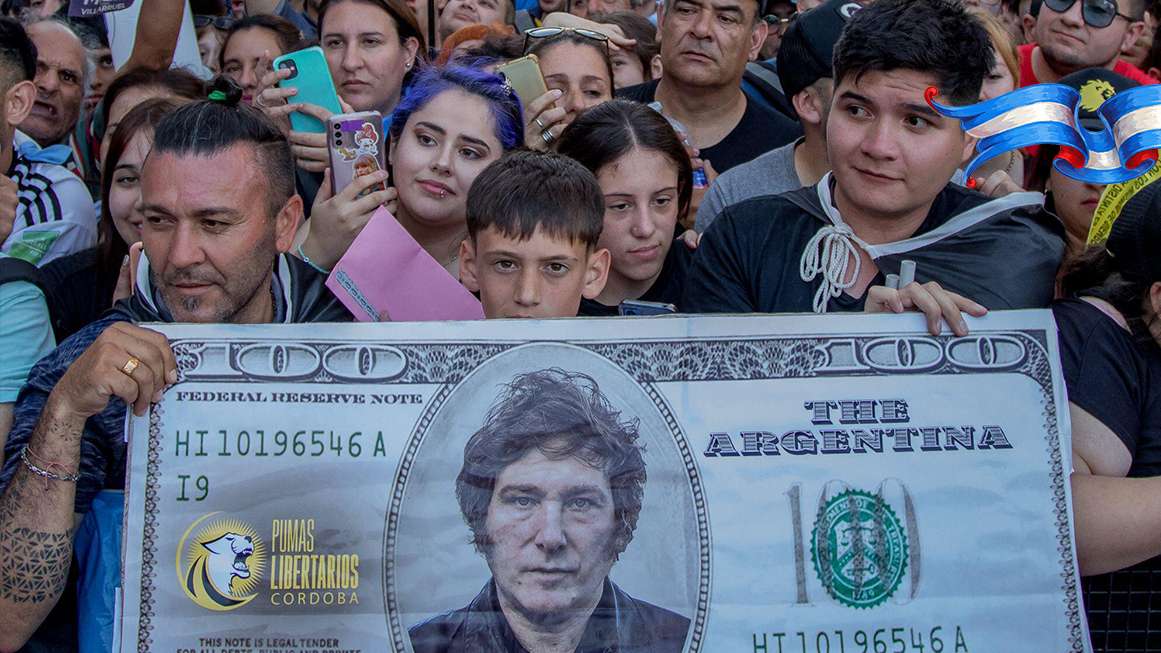
The language was crude, and the emotions were authentic. The contrast with Macri's genteel criticism of Peronists did the trick. Ratings soared with Milei's appearances, and clips of his TV outbursts on social media became increasingly viral. This created a spontaneous network of popular fan accounts across different platforms that shared nothing but Milei-related libertarian content. Their names speak volumes: "Milei the Wig" (El peluca Milei), "Grab the Shovel" (Agarrá la pala, a reference to Peronists' aversion toward private sector employment), "Alberdi's Heirs" (a nod to the 19th century "founding father" of Argentine classical liberalism). With hundreds of thousands of followers each, these and other channels formed an organic social media network that no politician could hope to match.
The key was that Milei himself was not a politician, or at least not at first. He aimed his main line of attack against the casta of professional "freeloaders of the state." This included the Peronists, of course, but also the Radicals and other parties from the center-right, whose members had failed conspicuously with Macri. Hence Milei's eventual slogan, "Out with them all!" (que se vayan todos), a phrase that first arose amid Argentina's financial collapse of 2001. Deploying a version of class warfare against the casta, he stressed that, while Argentines were steadily becoming poorer, only politicians of all stripes were thriving.
The way to overcome the casta, Milei said, was through a "cultural battle." This required dismantling the notion of "social justice," an "aberration" exemplified in Argentina by former first lady Eva Perón's dictum that "where a need arises, a right is born." Milei thus struck at the philosophical heart of Peronism, refuting the idea that the state had to tax productive citizens and intervene in their lives to guarantee a series of bogus rights that politicians conjured to fool, and ultimately bribe, their voters.
It was not enough, Milei stressed, to defend liberty based on the superior results that free markets produced, even if they were also worth underscoring. The new narrative had to emphasize the immorality of collectivism, which perversely uses the state's apparatus to force equality upon individuals who are by nature different. It had to challenge socialists' claims to moral superiority. It is the free market, Milei said time and again, that places the individual above the collective. As such, it is productively, morally, and aesthetically superior. The standoff was unavoidable, he thought, because a moderate, milquetoast, intermediary stance strengthens socialism. The cultural battle, he said, "is not for the lukewarm."
If equating needs with rights was the theoretical core of Peronism, its foremost economic tool was the Argentine central bank, with its indiscriminate use of the money printer to cover spending levels that far exceed the capacity of the Argentine state. In a sense, currency manipulation is the main strand of recent Argentine history. By monetizing large fiscal deficits, the central bank produced three separate episodes of hyperinflation between 1975 and 1989. After a respite in the 1990s, double-digit inflation levels have been the norm since 2002, and they once again surpassed 100 percent per year under Alberto Fernández. So Milei targeted the central bank as the main cause of Argentina's long-term economic malaise.
Since the Argentine Central Bank's founding in 1935, Milei wrote in a 2019 op-ed, it has been "an institutional scam in the hands of the political corporation's pillagers." He quoted Milton Friedman's maxim about inflation as a strictly monetary phenomenon "always and everywhere." He went further than Friedman, denying a need for central banks to exist in the first place. He said the only public office he would accept was the central bank's presidency—and just to abolish the institution. The reason: "the very act of printing money is a swindle."
This critique of the fiat money system and its catastrophic application in Argentina contradicted the main center-right stance, which held that the central bank needed only independence under responsible, technocratic management. Macri's technocrats had not, in fact, managed inflation responsibly. Milei's message struck a chord in a country where people routinely fled from the Argentine peso, with real estate transactions and car purchases carried out in U.S. dollars. Dollars were also the currency of choice for savings hidden in backyards and under mattresses (dólar colchón).
Milei used entertainment to drive his message through. Dressed as a superhero he named Captain Ancap, Milei sang his version of Verdi's brindisi (or drinking song) from the opera La traviata. Here is a rough translation:
To spend and to spend and to spend and to spend
That's our fiscal rule to the end
And since the deficit can only extend
The Central Bank surely will bend
And that will unleash inflation, and that will unleash inflation
If they still spend with no moderation
Into a full crisis we'll surely descend
The Alliance With Social Conservatives
Milei's message was not limited to economic theories. The anti–"social justice" component of his cultural battle was also a struggle against abortion (which he called a violation of the nonaggression principle), "gender ideology," "original settler" claims, environmentalism, and inclusive language, all of which he saw as weakening the fabric of Western civilization.
He forged an alliance with the Argentine writer and influencer Agustín Laje, who believed a form of "cultural Marxism" aimed to group all minorities with grievances into a single oppressed class. The liberation of minorities, Laje said, had become the oppression of the majority, through cancel culture and hate-speech laws.
By mid-2021, Milei's battle at the edge of politics had already produced the elements of an insurgent political movement. There were an outsider figure, influencers, legions of social media followers, the casta as the common foe, and a distinctive point of view that fused an anarcho-capitalist economic platform and a strong element of social conservatism.
The latter prevailed when it came to drugs as a political issue. Although Milei idolized Friedman, even naming one of his dogs in the economist's honor, he did not adopt Friedman's view of prohibition as a boon for drug cartels. Rather, he opposed relaxing drug laws, arguing that taxpayers must foot the bill for the treatment for addicts in a public healthcare system. Such positions might not pass a libertarian purity test, but they helped Milei broaden his political appeal.
In September 2020, Milei made his entry into politics official. On an Instagram Live session with José Luis Espert (a libertarian politician later to be embroiled in a corruption scandal), Milei said that "you can't change the system from the outside. You have to get in and blow it up from the inside."
In August 2021, he launched a new party, La Libertad Avanza (LLA), Spanish for "Liberty Advances." The alliance with conservatives was a centerpiece. As he ran to represent the City of Buenos Aires in the lower house of Congress, Milei needed a running mate. He chose Victoria Villarruel, best known for her activism on behalf of members of the security forces convicted of human rights abuses committed during Argentina's years of military rule, whom she claims are political prisoners. Villarruel extended the ticket's appeal beyond Milei's young, antiestablishment base.

Milei Runs for Office Under a New Banner
Not that the base was taken for granted. During his official campaign launch in Buenos Aires, Milei revealed LLA's logo of a roaring lion and sang a cover of "Panic Show," a rock hit by a band (La Renga) whose left-wing-leaning members were outraged by Milei's use of their music: "Hello to all, I am the lion/The beast roared in the middle of the avenue….I am the king of a lost world/I am the king and I will tear you apart/All accomplices fulfill my appetite."
The message was clear: The casta had nowhere to hide from a newly arrived pack of maned predators. "I didn't come here to guide lambs," Milei said. "I came to awaken the lions."
The casta proved resilient at first. When the November election came, Macri's party (Juntos por el Cambio) received 49 percent of the vote in Buenos Aires and the Peronists 25 percent. Not too far behind, Milei's LLA achieved 17 percent of the vote—a spectacular result for a new party led by a complete political novice. Milei was now a main player on the national stage.
Under the proportional representation system, LLA's third place finish gained them only two seats out of 13 for Buenos Aires in the Chamber of Deputies. Those seats were filled by Milei and Villarruel. When a journalist asked what the two alone could possibly achieve in Congress, Milei paraphrased a Bible verse from 1 Maccabees: "Victory does not depend on the size of your army, but rather on the forces of heaven." The phrase became yet another piece of LLA's rhetorical arsenal, and it was used frequently in the run-up to the 2023 presidential election.
While Milei was in Congress, Argentina's monetary system began to unravel, with annual inflation of 94 percent in 2022 and 211 percent the following year. The rapid, turbulent collapse validated Milei's long-held belligerence against the central bank, which many had once considered extreme. Extraordinarily, the central bank itself had begun to issue debt and ended up owing around $30 billion to commercial banks in ultra-short-term notes called LELIQs (letras de liquidez). These rolled over every 28 days and paid nominal interest rates that rose swiftly—to around 100 percent annually by mid-2023—as the central bank tried in vain to prop up a sinking peso. But inflation outpaced the sharp rate hikes. As new LELIQs were issued to pay for ones coming due, the central bank's liabilities came to double the size of the monetary base. The result was one of the largest fiscal time bombs in recent monetary history.
The Peronists made the further mistake of naming their strongest choice as a presidential candidate, Sergio Massa, as Fernández's finance minister in 2022. This meant that Massa could not blame someone else for the monetary catastrophe he was overseeing during the campaign. Milei, meanwhile, called for the closure of the central bank and the full, official dollarization of the economy. By July 2023, nearly a third of Argentines supported this alternative. Massa seemed to be his own rival's unwitting ally.
Before taking on Massa head-to-head in the presidential election runoff, Milei had to get past Patricia Bullrich, a member of Macri's party. Milei's conservative turn helped in his race against the far more experienced Bullrich, who had joined Peronist youth circles and had ties to armed left-wing militants in the 1970s. Bullrich called Milei "emotionally unstable" and filed a criminal complaint against him for suggesting she had been involved in acts of terrorism. In the first round of voting, Milei gained 30 percent of the vote vs. Bullrich's 24 percent. Massa had come in first place with 37 percent—but since he was short of a majority, there would be a runoff. Bullrich and Macri then endorsed Milei to prevent a Peronist victory. The result: Milei won and later proclaimed himself the world's first "liberal-libertarian" president.
According to the old playbook, pro–free market intellectuals had to persuade F.A. Hayek's "second-hand dealers in ideas," the pundits and commentators who could shift public opinion. Milei broke the model. A born showman, he himself changed the terms of political debate, persuaded huge swaths of the public directly, bypassed the media intermediaries, and proceeded to win Argentina's presidency.
The post How Milei Won appeared first on Reason Magazine.
FIP XML/RSS/RDF Newsfeed Syndication https://freeinternetpress.com/rss.php
© 2026 FreeInternetPress.com
Free Internet Press is licensed under a Creative Commons Attribution 3.0 United States License. You may reuse or distribute original works on this site, with attribution per the above license. Any mirrored or quoted materials may be copyright their respective authors, publications, or outlets, as shown on their publication, indicated by the link in the news story. Such works are used under the fair use doctrine of United States copyright law. Should any materials be found overused or objectionable to the copyright holder, notification should be sent to [email protected], and the work will be removed and replaced with such notification.
Please email [email protected] with any questions.