

Greg Abbott Once Called Texas the 'Epicenter' of AI. Now He's Freezing Data Center Construction.
There seem to be very few issues that Republicans and Democrats can agree on these days, but disdain for data centers sure is one of them.
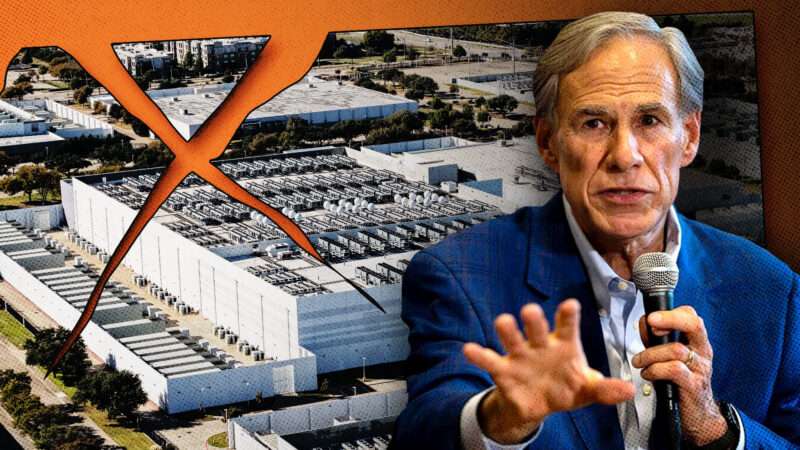
On Monday, Texas Republican Gov. Greg Abbott halted all new data center construction in the Lone Star State, pending "a comprehensive verification and audit" of all new data center projects hoping to connect to the state's power grid. As E&E News reports, the order will require prospective data centers to give "information about their proposed water use, tax breaks they receive, what cooling technologies they're using and who owns the projects" to the Public Utility Commission (PUC) and the Electric Reliability Council of Texas (ERCOT)—which oversees about 90 percent of the state's grid.
Any project that doesn't comply "must be denied connection to the Texas grid," Abbott wrote in a letter to PUC Chairman Thomas Gleeson and ERCOT President and CEO Pablo Vegas.
ERCOT "is currently considering approximately 474 gigawatts of requests to connect to the Texas grid," about 90 percent of which are associated with data centers, Abbott wrote. "That is more than five times Texas' record peak electricity demand for ERCOT….That unprecedented load growth could endanger the reliability and stability of the Texas electric grid."
"Simply put," he added, "Texans must come first."
Concerns over energy affordability, grid reliability, and water usage have sparked a nationwide pushback against data centers. In July, New York Democratic Gov. Kathy Hochul, citing many of the same arguments as Abbott, issued the nation's first moratorium on new data center construction. In April, Maine became the first state to pass a moratorium on these facilities, which Democratic Gov. Janet Mills later vetoed.
Still, the order is surprising considering that a year ago Abbott touted Texas as the "'epicenter' of artificial intelligence development as he courted megaprojects," per E&E News. It's also unnecessary, given that ERCOT was already taking steps to address the problem.
In June, ERCOT proposed a "Batch Zero Process for Large Load Interconnections."
Under the new structure, which was approved that month, ERCOT will consider power-hungry entrants hoping to connect to the grid in batches—rather than individually—to speed up the approval process. To be considered, applicants must pay a deposit to front the cost of grid upgrades and show they have a "contracted customer, a signed lease agreement or deed for the land they're building on, and orders for the equipment they need, among other requirements," the Houston Chronicle reported in June.
This framework was designed to "help weed out the serious applicants from the unserious ones," writes Reason's Tosin Akintola, which could go a long way in reducing the 474 gigawatts' worth of requests on the state grid. Similar rules set by Chicago-based Exelon earlier this year to filter out unserious applicants yielded a 40 percent decline in expected data center load in the second quarter of 2026.
As is often the case in the data center debate, politics seems to be shaping Abbott's decision. In a poll conducted by the University of Texas/Texas Politics Project released in June, 56 percent of self-reported Texas voters said they opposed data center construction in their community. With Abbott up for reelection and leading his challenger, state Rep. Gina Hinojosa (D–Austin), by slim margins (at least for a Texas Republican), the move appears to be a ploy to win over voters ahead of the November election.
If his goal was to appeal to populist sentiment, there are several other things that Abbott could have proposed that would have been less harmful to the state's burgeoning AI sector, including eliminating the generous tax credits the state offers the industry and giving data centers more leeway to construct their own power plants off the grid and without regulatory oversight (which could reduce costs for consumers and strain on the grid). Instead, Abbott elected to use his expansive power to halt the construction of facilities that offer immense economic benefits for minimal environmental downsides.
With about 70 percent of Americans opposing the buildout of data centers in their communities, according to a recent Heatmap Pro poll, the data center wars are unlikely to end anytime soon. And if Texas—the market-friendly, energy capital of the world—is willing to issue a de facto moratorium on these centers, expect other states to follow.
The post Greg Abbott Once Called Texas the 'Epicenter' of AI. Now He's Freezing Data Center Construction. appeared first on Reason.com.
FIP XML/RSS/RDF Newsfeed Syndication https://freeinternetpress.com/rss.php
© 2026 FreeInternetPress.com
Free Internet Press is licensed under a Creative Commons Attribution 3.0 United States License. You may reuse or distribute original works on this site, with attribution per the above license. Any mirrored or quoted materials may be copyright their respective authors, publications, or outlets, as shown on their publication, indicated by the link in the news story. Such works are used under the fair use doctrine of United States copyright law. Should any materials be found overused or objectionable to the copyright holder, notification should be sent to [email protected], and the work will be removed and replaced with such notification.
Please email [email protected] with any questions.