

An Ungrateful Public Underappreciates Data Centers
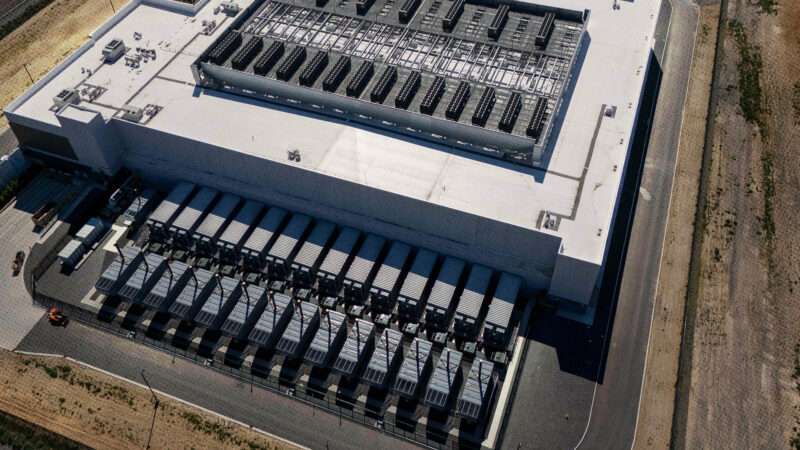
When data center opponents seek to hype the environmental strains caused by these facilities, they often describe their water and electricity usage in terms of household or community equivalents.
This data center will consume as much electricity as a small town. That data center's water usage is the same as 50,000 homes.
The implied takeaway is that this is a lot. But it's not really.
In today's modern economy, the individual household is a mostly production-free zone. Where we once grew our own food and made our own clothes, today we buy those things from large enterprises that produce them offsite.
While the amount of resources individual households in rich countries consume is gargantuan, the resources needed to run individual homes that are mostly used for sleeping, eating, and child-rearing are relatively insignificant.
A data center using as much power as 50,000 homes sounds pretty scary. A data center using as much power as a single steel plant sounds less impressive.
The fact that data centers also allow us to outsource the electricity and water needed to power the digital services we consume is one of their many unsung benefits, as a recent X post accidentally highlights.
Earlier this week, X user Scott predicted that in five to 10 years' time, everyone will have a miniature AI data center in their house, sandwiched between the fridge and the dishwasher.
I predict that in 5-10 years every household will have a local AI server that serves all the AI workload of the house, digital or robotics. It'll be as common as a WiFi router or a fridge
it creates a private mesh network to link all the devices in the house and does inference… pic.twitter.com/bJA3oVEti2
— Scott (@scottstts) August 19, 2026
Some of the quote tweets sarcastically predicted we'd also be building our own in-home smelting infrastructure.
I predict that in 5-10 years every household will have a backyard furnace that serves all the pig iron production needs of the house https://t.co/VeM76HqzOK
— A. V. Dremel
(@BmoreOrganized) August 19, 2026
We obviously don't need to make our own pig iron at home when a large capital enterprise, taking full advantage of economies of scale, can do it more efficiently elsewhere.
The benefits to consumers are cheaper finished goods and a cleaner, more tranquil home that's also cheaper to run.
Data centers provide the same benefits to households in our modern, tech-dominated economy.
It's a nice thing that we can access almost every song ever recorded and view detailed street maps of the entire globe without a hot, noisy, power-hungry box taking up precious counter space in our homes.
Instead, we rely on remote data centers and their vast reserves of information storage and computing power to do that and then beam it to slim TVs, portable phones, and laptops.
As Reason has covered, the negative impacts of data centers are massively exaggerated. It's equally true that their benefits, in terms of less in-home hardware and resource consumption, are massively underappreciated.
Recent polling by Echelon Insights found that 62 percent of respondents would oppose an AI data center being built in their community. That makes them less popular than nuclear power plants.
The same poll found that a data center supporting digital services like online search and streaming was still heavily underwater, with 53 percent opposing one in their community.
One can assume that most of the opponents of such data centers in that poll still use Google and streaming services. Would those people really want the expense and nuisance of running their own data center instead?
Unfortunately, this benefit is occasionally missed or underplayed by defenders of data centers.
When these few, proud, data center stans have tried to rehabilitate their reputation, they often do so by pointing to the public services paid for by taxes on data centers.
They'll tout a North Dakota town repaving its roads and building a new senior center with taxes paid by data centers as evidence of these facilities' wider benefits.
While it's certainly nice that Ellendale gets a new senior center, that's a minor, localized benefit at best.
The primary benefit of any profit-making production facility is what it produces, not the taxes it pays or the public services it supports.
Defending data centers by pointing to the fiscal benefits they provide local governments risks missing that point. Worse still, it encourages localities to treat data centers as cash cows there to pay for services that should be borne by all taxpayers.
To the degree that local taxes result in fewer data centers, we're all actually worse off.
If people want to be mad about something, they should be mad about Ellendale's senior center, and the fact that this local benefit, and others like it, are paid for by making data centers more expensive to run and the services they provide less economically enticing to investors.
Instead, people are increasingly focusing their anger on the data centers merely trying to help them. It's a bad attitude, and it will lead to bad policies that further restrict data centers.
The post An Ungrateful Public Underappreciates Data Centers appeared first on Reason.com.
FIP XML/RSS/RDF Newsfeed Syndication https://freeinternetpress.com/rss.php
© 2026 FreeInternetPress.com
Free Internet Press is licensed under a Creative Commons Attribution 3.0 United States License. You may reuse or distribute original works on this site, with attribution per the above license. Any mirrored or quoted materials may be copyright their respective authors, publications, or outlets, as shown on their publication, indicated by the link in the news story. Such works are used under the fair use doctrine of United States copyright law. Should any materials be found overused or objectionable to the copyright holder, notification should be sent to [email protected], and the work will be removed and replaced with such notification.
Please email [email protected] with any questions.