

6th Circuit Backs Ban on Ohio Minors Using Social Media Without Parental Permission
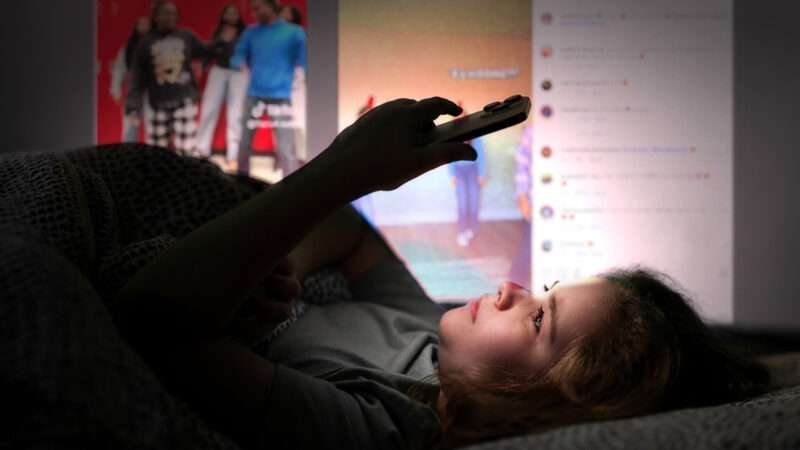
A federal appeals court has signed off on Ohio's ban on people under age 16 using social media without parental consent. That means all Ohioans could soon have to show ID to use such platforms as Facebook or X.
A U.S. District Court previously blocked the law, ruling it unconstitutional. But the state appealed, and now a divided 2–1 panel of federal appeals court judges has sided with the state.
Similar laws have been either temporarily or permanently blocked by federal courts in other states, such as Arkansas, Louisiana, and Utah. That makes the 6th Circuit's decision something of an aberration—and a worrying sign. And I don't just say that because I live in Ohio (though, you know, also: yikes).
Until now, federal courts had seemed aligned in finding laws like Ohio's to be unconstitutional. But the 6th Circuit judges think these rules constitute only "a marginal burden."
Ohio's Social Media Parental Notification Act was signed by Gov. Mike DeWine in 2023. On any website that is reasonably likely to be accessed by minors and where people can interact socially, have a profile, friend other users, and create posts, the law requires people under age 16 to get parental consent before they can create accounts.
The law was challenged by the tech industry trade group NetChoice (which also challenged the Arkansas, Louisiana, and Utah laws and others like them). NetChoice argued that the law "condition[ed] all Ohioans' First Amendment right to share and receive information online on their willingness to hand over their most sensitive, personal data to age-verification services" and that it "implicates a vast territory of speech that lies at the heartland of First Amendment protection."
The U.S. Court of Appeals for the 6th Circuit rejected this interpretation. The Social Media Parental Notification Act "does not raise meaningful concerns about muting valuable protected discourse," said the lead opinion, penned by Judge Eric L. Clay.
I'm sorry—what?
Requiring websites and apps to apply special rules to minors requires their operators to know who is a minor, which requires them to collect IDs (or do some other form of age and/or identity verification) from all users. And a mandate that everyone must attach their real name or face to every online account undoubtedly will chill speech.
There are many reasons why folks might not speak freely online after their accounts are tied to their government IDs or to pictures of their faces. People with politically unpopular opinions, people with marginalized identities, people with potentially embarrassing health questions…the list could go on and on.
Clay's bit about this law not "muting valuable protected discourse" came in the context of discussing the effect on minors. But minors have First Amendment rights too. They face the same identity-based chilling effect that adults might, plus the added burden of being banned from online platforms entirely if their parents won't sign on.
Clay writes that "even if a maximalist construction of the First Amendment right were entirely exploitative of and deleterious to minors, NetChoice would presumably still support it. Therefore, permitting NetChoice to challenge the facial validity of the Act based on Children Users' First Amendment rights would be imprudent."
Again: what? Clay has concocted a hypothetical—that minors are definitely harmed by social media, that having First Amendment rights is bad for them, and that NetChoice doesn't care about minors—and then decided that based on this hypothetical, NetChoice can't possibly represent the interests of the minor users of the tech companies it represents.
"My colleagues discuss whether the minor users' 'best interests' align with NetChoice's members generally…and whether NetChoice's interests and the interests of minor users diverge," Judge Kevin G. Ritz writes in a dissenting opinion. Quoting Amato v. Wiltentz, he notes that "the relationship between the third party and the plaintiff only counts insofar as it is linked to the right asserted." And thus, he concludes, "the First Amendment interests of NetChoice overlap neatly with the First Amendment interests of its members' minor users."
In other words, minors do have a First Amendment right to use these platforms—and it doesn't matter if the Ohio attorney general or Judge Clay think that exercising that right is too dangerous.
Ritz goes on to point out that while social media platforms may pose some risks for minors, they may also be beneficial:
Although the websites the Act seeks to regulate may pose serious risks to children, these sites are also zones for constitutionally protected speech. And they cultivate "vast democratic forums" with the "potential to alter how we think, express ourselves, and define who we want to be." Indeed, the Supreme Court has described social
media platforms as "perhaps the most powerful mechanisms available to a private citizen to make his or her voice heard."
The parental-consent provision at the core of the Act represents a significant burden on
the rights of NetChoice's minor users to avail themselves of these "powerful mechanisms" of speech. For many minor users, in fact, the Act would represent an "insurmountable [ ] barrier to entry for online speech."…
Like my colleagues and Yost, I do not doubt 'that unfettered social media access can and does harm minors.' But the state does not have 'a free-floating power to restrict the ideas to which children may be exposed.'
IN THE NEWS
The Iowa Supreme Court dismissed human trafficking charges against a man named Kevin Lind, noting that at the time that he was charged, the state's trafficking law required either a real victim or a real trafficker and this case had neither. "Lind was arrested after he arranged to meet with a law enforcement officer posing online as a 13-year-old girl," reports KCCI.
Iowa has since changed its law to allow human trafficking prosecutions in which the "victim" is actually a "law enforcement officer or agent posing as a person subjected to or a target for human trafficking."
Iowa is far from unique in its new law. A ton of states allow this, and many "human trafficking busts" that make headlines involve neither real traffickers nor real victims. In my experience covering this topic, a huge number of "trafficking" busts come from cases where police posed online as a teenager and then arrested men who solicited the "teen" for sex.
Read This Thread
Malaysia has a horrible record on inernet freedom- and freedom generally. I'm not pig-headed - I can understand congratulating free countries in policies I have problems with. But Malaysia? Come on. https://t.co/ceG7UtKXcD pic.twitter.com/MHqlg5gCNu
— Shoshana Weissmann, Sloth Committee Chair
(@senatorshoshana) June 21, 2026
More Sex & Tech
My new study finds that adverse childhood events, but not age of acquisition of #smartphones or #tablets is related to young adult #mentalhealth.
Based on data from the Global Minds Project.
Just one little study, but disconfirms beliefs parents should be told not to give young…
— Chris Ferguson
(@CJFerguson1111) June 17, 2026


• "On Friday, the government's Section 702 surveillance authority lapsed! It may be temporary, but it's still an important milestone," notes Mike Masnick at Techdirt.
• The Texas Republican Party has adopted an anti-IVF plank in its new platform.
• "If AI can now do all kinds of labor, then ordinary people will soon be able to afford their own employees," writes Lane Brown in a New York magazine piece about Jesse Genet, a homeschooling mom of seven who employs a staff of AI agents. "That optimistic AI future is still a ways off, if it's even possible at all. But Genet is already living in a rough draft of it."
• Identity verification schemes are moving beyond porn websites and social media and now extending to computers and phones. "Two US states have already passed laws requiring your operating system to collect your age, and a federal law is under discussion," reports PC Mag. "After more than two dozen states passed laws targeting adult websites like PornHub—and Utah moved against VPN use—the next battleground is your operating system."
• Moral panic around technology has gotten so out of control that people are now proposing taxes on streaming video services. Pssst:
Singling out a particular medium of expression for taxation would likely violate the First Amendment. See Minneapolis Star v. Minnesota Comm'r, 460 U.S. 575 (1983). https://t.co/mrHbIq1lqs
— Ben Sheffner (@bensheffner) June 18, 2026
The post 6th Circuit Backs Ban on Ohio Minors Using Social Media Without Parental Permission appeared first on Reason.com.
FIP XML/RSS/RDF Newsfeed Syndication https://freeinternetpress.com/rss.php
© 2026 FreeInternetPress.com
Free Internet Press is licensed under a Creative Commons Attribution 3.0 United States License. You may reuse or distribute original works on this site, with attribution per the above license. Any mirrored or quoted materials may be copyright their respective authors, publications, or outlets, as shown on their publication, indicated by the link in the news story. Such works are used under the fair use doctrine of United States copyright law. Should any materials be found overused or objectionable to the copyright holder, notification should be sent to [email protected], and the work will be removed and replaced with such notification.
Please email [email protected] with any questions.