

3 Leading News Outlets Say Their Sudden Banishment From the White House Is Unconstitutional
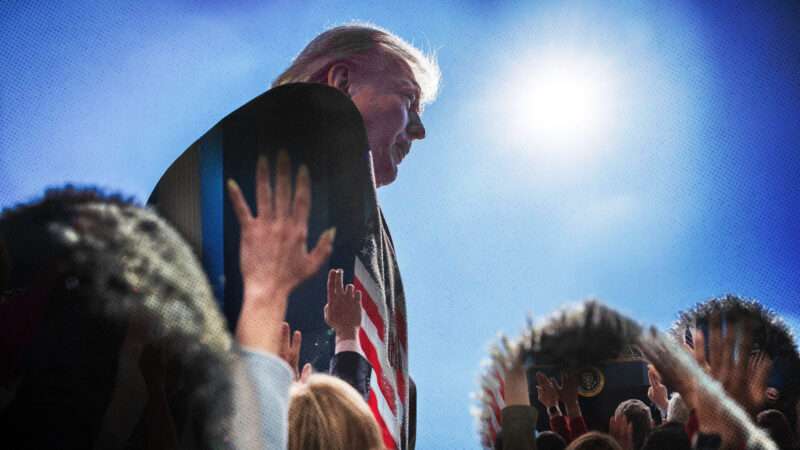
On Friday, President Donald Trump said he was "proud to announce" that, "effective immediately," he was "banning" CNN, MS NOW (formerly MSNBC), and Politico "from the White House as a result of their constant 'reporting' [of] FAKE NEWS!" News organizations "shouldn't be able to constantly write or report FICTION and LIES when they're covering the President of the United States, the Trump Administration, or the United States of America," he explained. "Other Fake News Media Outlets to follow."
That move predictably provoked a federal lawsuit by the targeted outlets, which argue that it violates due process and freedom of the press. "This ban could not be a more direct assault on the First Amendment [or] a more blatant violation of our most fundamental constitutional principles," CNN et al. say in their complaint, which they filed on Monday in the U.S. District Court for the District of Columbia.
The lawsuit recapitulates issues raised by Trump's previous legal battles with the press. Back in 2018, U.S. District Judge Timothy J. Kelly, the same Trump appointee who has been assigned to this case, issued a temporary restraining order that blocked the White House from revoking CNN reporter Jim Acosta's "hard pass," which allows a journalist to participate in press events on an ongoing basis.
Explaining his decision during a hearing, Kelly cited Sherrill v. Knight, a 1977 decision by the U.S. Court of Appeals for the D.C. Circuit that addressed the denial of a hard pass based on an "adverse recommendation" from the Secret Service. "If Sherrill stands for anything," Kelly said, it establishes that "the Fifth Amendment's Due Process Clause protects a reporter's First Amendment liberty interest in a White House press pass."
Under Sherrill, Kelly ruled, a reporter threatened with the loss of his hard pass must receive advance notice, "an opportunity to rebut the government's reasons," and "a written decision." But in Acosta's case, the White House had not met any of those requirements.
In fact, Kelly said, "whatever process occurred within the government is still so shrouded in mystery that the Government could not tell me at oral argument who made
the initial decision to revoke Mr. Acosta's press pass." He added that the government's "belated efforts" to justify the decision, including tweets by the press secretary and "a written statement of explanation" that was "apparently prompted by this litigation," were "hardly sufficient to satisfy due process."
Kelly did not address CNN's First Amendment claims, and the Trump administration avoided a full airing of those issues by backing down. After the White House restored Acosta's press pass, CNN agreed to drop the lawsuit. But in the 2020 case Karem v. Trump, which involved a one-month suspension of an allegedly "unprofessional" journalist's hard pass, the D.C. Circuit confirmed that due process applies to such decisions.
By that standard, CNN et al. argue, Trump's banishment of "fake news" outlets is plainly deficient. The president announced his decision out of the blue, explaining only that he was punishing the plaintiffs because he viewed their coverage as "purposely negative," "one-sided," and "never good." They "want to try and diminish the Republicans and a Republican administration," he complained, saying his decision was prompted by "cumulative stories over the last two years" that made him "sick."
That night, according to the complaint, the White House "deactivated" the hard passes of CNN et al.'s employees. And the next morning, "White House officials denied access and seized the credentials of journalists with those organizations when they attempted to enter the White House to do their jobs."
CNN, MS NOW, Politico, and the journalists they employ "have liberty and property interests in their press credentials and the access those credentials afford to the White House grounds to report on the President and his administration," the lawsuit says.
"The ban deprives them of those interests without meeting the bare minimum requirements of due process: advance notice based on clear standards and an opportunity to be heard."
Trump "provided no notice that he would immediately deny news organizations whose reporting he disliked access to the White House grounds," the plaintiffs note. "Nor did he provide clear standards for his decision. And the President did not provide CNN, MS NOW, or POLITICO, or any of their journalists, any opportunity to be heard before he announced the ban in a social media post and before the White House terminated reporters' access and confiscated press credentials."
The plaintiffs also argue that the bans violate the First Amendment by discriminating against them based on viewpoint and retaliating against them for constitutionally protected speech. U.S. District Judge Trevor N. McFadden, another Trump appointee, deemed such arguments plausible last year, when he issued a temporary restraining order against Trump's banishment of Associated Press reporters from the Oval Office, Air Force One, and White House briefings and press conferences.
As with CNN et al., Trump made it clear that he was motivated by journalism that offended him—in particular, the A.P.'s refusal to adopt the president's new name for the Gulf of Mexico. As McFadden saw it, even a "limited space" such as the Oval Office qualified as a "nonpublic forum," meaning that decisions to exclude particular news outlets must be "reasonable" and cannot be based on viewpoint. He therefore concluded that the A.P. was likely to prevail on its First Amendment claims.
The D.C. Circuit partially stayed McFadden's order in June 2025, drawing a distinction between "limited spaces" and "events open to all credentialed White House journalists," such as East Room press conferences. The appeals court heard oral argument in the case last November but has not issued a decision yet.
Notably, Trump's bans on CNN, MS NOW, and Politico extend to all White House settings, including spaces open to all journalists with hard passes. Even if the D.C. Circuit ultimately rules that settings limited to the much narrower "press pool" are not "nonpublic forums," that rationale would not justify the blanket exclusion of CNN et al., which they say ticks all the boxes required for a retaliation claim.
"First, Plaintiffs' coverage of the President and his administration is core First Amendment activity," the complaint says. "Second, banning Plaintiffs from the White House grounds is precisely the type of adverse action that would deter journalists and news organizations of ordinary firmness from continuing to provide fact-based, independent coverage of the administration that the President dislikes. Indeed, that is the entire point of the ban: The President has admitted his hope that the ban will coerce positive coverage from Plaintiffs by offering that, if they 'could straighten themselves out,' then the President would 'love it.'" Finally, Trump "has made explicit the causal link between the ban and Plaintiffs' coverage of him and his administration."
The bans also qualify as unconstitutional viewpoint discrimination, CNN et al. argue. "A 'nonpublic forum' is 'government property' that the government has opened to speech for selected speakers," they note. And last year in Ateba v. Leavitt, the D.C. Circuit "held that the 'White House Press Area'—including 'the briefing room, the press offices, and certain other locations in and around the White House'—'is a nonpublic forum' because the government 'provides selective access for individual speakers.'" That means "any restrictions on access to those press areas [must] be both viewpoint neutral and 'reasonable in light of the purpose served by the forum.'"
Trump's banishment of CNN et al. clearly does not meet that test because it is "neither viewpoint neutral nor reasonable," the plaintiffs argue. Trump "has expressly targeted Plaintiffs based on their perceived editorial viewpoints," they note. And "while certain speaker-based access restrictions may be reasonable to further the purposes of a forum, banning speakers based on the President's personal dislike for their perceived views does nothing to promote the purposes of the White House press areas."
Trump's exclusion criteria—i.e., his perception that an outlet's coverage is "fake" or "purposely negative"—are "so vague and arbitrary that they cannot count as a 'sensible basis for distinguishing what may come in from what must stay out' and are thus unreasonable," the complaint says. It adds that Trump's "claim to standardless discretion to ban White House access to credentialed news organizations and reporters is unreasonable."
In Ateba, the D.C. Circuit "squarely" held that "the exercise of unbridled discretion to deny access to a nonpublic forum is unreasonable," CNN et al. note. "The President's ban is just such a raw exercise of unbridled discretion to exclude disfavored media organizations from the White House."
Kelly has ordered a government response to the lawsuit by the end of Tuesday, and a hearing on the plaintiffs' motion for a temporary restraining order is scheduled for Wednesday afternoon. While Kelly never weighed in on the First Amendment claims that Acosta raised in 2018, the due process concerns that he found compelling in that case are only amplified by the sudden deactivation of press passes for more than 60 journalists employed by three leading news organizations.
The post 3 Leading News Outlets Say Their Sudden Banishment From the White House Is Unconstitutional appeared first on Reason Magazine.
FIP XML/RSS/RDF Newsfeed Syndication https://freeinternetpress.com/rss.php
© 2026 FreeInternetPress.com
Free Internet Press is licensed under a Creative Commons Attribution 3.0 United States License. You may reuse or distribute original works on this site, with attribution per the above license. Any mirrored or quoted materials may be copyright their respective authors, publications, or outlets, as shown on their publication, indicated by the link in the news story. Such works are used under the fair use doctrine of United States copyright law. Should any materials be found overused or objectionable to the copyright holder, notification should be sent to [email protected], and the work will be removed and replaced with such notification.
Please email [email protected] with any questions.