
"The Three Words That Explain American Government: 'Right to Sue,'" by Stanford Law Prof. Diego Zambrano
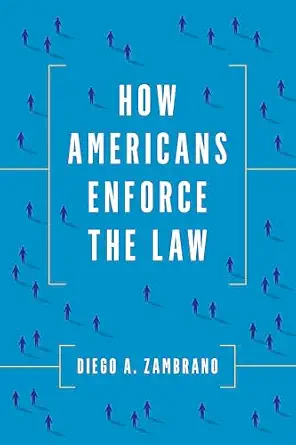
I read and much enjoyed—and highly recommend—my Stanford colleague Diego Zambrano's book, How Americans Enforce the Law. He was kind enough to write up for us this post that captures the core of his argument, and I'm delighted to pass it along (though I encourage people to read the whole book):
The headlines are full of stories about a federal government retreating from enforcement. Agencies are dropping investigations, abandoning regulations, shrinking staffs and changing enforcement priorities. One week, the EEOC dropsdiscrimination cases. The next week, the SEC and CFPB wind down investigations into securities fraud and wrongdoing affecting consumers. Critics fear that the Department of Justice's antitrust division will overlook mergers when it is convenient for the administration. And the DOJ has abruptly reduced enforcement of the Foreign Corrupt Practices Act. Facing these changes, Americans might worry that a wide range of laws will go unenforced.
But that concern misses something unique about the American system of government. We have never relied only on bureaucrats to enforce our laws.
All the way back to the colonial period, American legislators have repeatedly done something unusual: they have given ordinary people the right to sue alongside government officials. In almost every regulatory area that most Americans care about—be it regulation of wages and hours, environmental pollution, consumer protection, or securities fraud—statutes allow both government officials and private parties to file suit to enforce the law. All of this happens through little-known provisions called "private rights of action," which is just a technical name for a right to sue. Thousands of these provisions build a second enforcement system alongside the bureaucracy, turning employees, consumers, competitors and their lawyers into co-enforcers of public law.
This system of private enforcement of the law is highly unusual. In much of the rest of the world, whenever a government faces a regulatory problem, it typically empowers government officials and bureaucrats to police legal violations. In France, Germany, Japan, and even the UK, legislators are far less likely to let anyone sue over, say, environmental pollution or employment discrimination.
Consider the case of oil spills. In 1989, the United States faced the Exxon Valdez oil spill off the pristine waters of Alaska. Millions of gallons of oil laid waste to coasts, waters, and fisheries for hundreds of miles. What most Americans don't know is that a decade later, France also faced a catastrophic oil spill, caused by a ship called the Erika. So how did governments react? In the United States, private plaintiffs sued Exxon directly under existing tort and maritime law, eventually winning substantial damages. Congress, meanwhile, enacted a statute called the Oil Pollution Act with a new right-to-sue those responsible for oil spills. By contrast, in France, the oil spill led primarily to a major criminal prosecution and, eventually, to new national and European regulatory measures (including a new bureaucracy called the European Maritime Safety Agency). When France finally adopted a right to sue in 2016, it paled in comparison to the American version.
Why is the United States so different? Part of the answer, as I argue in a new book, is that Americans have always done this. Back in the colonial period, state legislatures adopted what they called "penal statutes," that empowered any person to enforce regulatory statutes and collect a bounty. So when Massachusetts wanted to regulate the storage of gunpowder, it allowed private informers to sue neighbors who stored it improperly. And this model applied across many areas of colonial life: alcohol consumption, trade, taxation, public morals, church attendance, and more. The Founders used the same tool across the board: Thomas Jefferson and James Madison co-wrote Virginia statutes full of penal statutes, and John Adams handled these suits routinely as a colonial lawyer.
The key feature of this system is that even though private parties file suit for their own aims—the employee wants their full wages paid or the consumer wants a refund for a shoddy product—they inevitably enforce the law. And those lawsuits benefit everyone else because employers and manufacturers may change their behavior with respect to other employees and consumers. In that sense, every single plaintiff is a little bureaucrat or, as some courts call them, a "private attorney general."
This system has the added benefit of reducing political disruptions in enforcement. Even though any single administration can change the enforcement priorities of the EEOC, SEC, CFPB, or Department of Justice, the president cannot control thousands of lawyers and their clients. Private enforcement, then, makes enforcement less dependent on what the bureaucracy and president want.
Right. So you might think that when the bureaucracy won't pursue wrongdoing, the obvious solution should always be new rights to sue. Indeed, many news stories decrying a lack of government enforcement immediately call for more private lawsuits.
But there's a problem with that solution. Private enforcement is not tailor-made for every regulatory area. It makes the most sense to empower private parties when the bureaucracy is truly faulty, under-resourced, politically vulnerable, or likely to be captured by regulated entities. When this isn't the case, private enforcement can cause more problems than it solves.
Consider, then, the enormous problems that rights to sue pose in the environmental context and in the construction of housing and infrastructure. There, broad rights to challenge government approvals can let private parties oppose the construction of housing, mass transit, green energy, and other projects. Examples of ruinous lawsuits abound. Neighbors in a Maryland suburb—backed for years by a nearby country club—sued to delay the Purple Line light-rail project over concerns for a microscopic organism, while the Sierra Club sued to stop a major Mojave solar energy project over the potential impact to a desert turtle. So even if a city government has approved a project that might benefit thousands of people, a single crank can use a right-to-sue to stop the project. In these settings, rights to sue have contributed to delays and increased costs of housing and infrastructure.
We need a careful approach to rights to sue. Yes, we need more of them in some areas. Especially if the government won't enforce anti-corruption or consumer protection statutes. And yes, in employment law, securities, and antitrust, private enforcement often makes a lot of sense. But this is not necessarily the case in environmental law and construction. There, we need better bureaucracies, not thousands of people with the ability to oppose construction projects for any number of reasons.
When the bureaucracy retreats, Americans should rest assured that private parties will still enforce the law. But that power to enforce the law should be given carefully.
The post "The Three Words That Explain American Government: 'Right to Sue,'" by Stanford Law Prof. Diego Zambrano appeared first on Reason Magazine.
FIP XML/RSS/RDF Newsfeed Syndication https://freeinternetpress.com/rss.php
© 2026 FreeInternetPress.com
Free Internet Press is licensed under a Creative Commons Attribution 3.0 United States License. You may reuse or distribute original works on this site, with attribution per the above license. Any mirrored or quoted materials may be copyright their respective authors, publications, or outlets, as shown on their publication, indicated by the link in the news story. Such works are used under the fair use doctrine of United States copyright law. Should any materials be found overused or objectionable to the copyright holder, notification should be sent to [email protected], and the work will be removed and replaced with such notification.
Please email [email protected] with any questions.